Homotopy of Paths
Recall the definition of a homotopy:
A homotopy is a continuous deformation of one function into another. Formally, given two continuous functions
Link to original, where are topological spaces, a homotopy between and is a continuous function such that and . One says that two maps and are homotopic, if there exists a homotopy from to , and denoted . For -manifolds, we can also define -homotopy by requiring the homotopy to be -smooth.
Let
Closed Path Homotopy, Path with Constant Endpoints Homotopy
Homotopy
is called a CP-homotopy if each is a closed path. i.e., for all . is called a PCE-homotopy if the beginning and end points of the paths are independent of . i.e. and for all .
e.g. The paths
Lemma
Every closed path in
is CP-homotopic in to one of the form , for .
The Homotopy Invariance Theorem
Lemma
Proof Assume the contrary. Then for all
Homotopy Invariance Theorem
Suppose
for some domain , and are two piecewise paths in . Let be a homotopy from to . Let and be the paths followed by the initial and final points of the homotopy respectively. Then
Proof The required equation is equivalent to 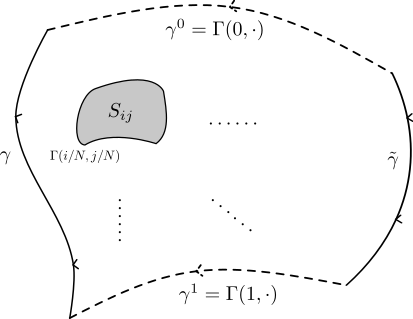 We will chop it into
Corollary
Suppose
for some domain . If and are CP-homotopic or PCE-homotopic, then
Proof If
e.g.
Simply Connected Domains
Simply Connected Domain
A domain is called simply connected if every closed path in
is CP-homotopic to a constant path.
Simply Connected Domain Characterisation
For a domain
, the following are equivalent:
is simply connected. is connected. in is connected. Moreover, if
is bounded, then these are also equivalent to
e.g.
Proposition
If
is simply connected and , then for every closed we have
Proof Since on a simply connected domain, every
Corollary
If
is simply connected and , then has a primitive.
Proof Directly from the theorem.
Proposition
Continuous maps preserves simple connectedness.