The Argument Principle
Lemma
Suppose
with holomorphic in a neighborhood of and . Then has a pole of order at with residue .
Proof
Argument Principle
Let
be a bounded Jordan domain, and let . Let , and assume that every is a pole of , with order ). Let be the zeroes of , with orders . Let and . Suppose that f has no zeroes on . Then
Proof We have
A Geometric Understanding of
The function
wants to be the derivative " " if were holomorphic on the domain. What happens is that the integral picks up the change in value of as you follow the boundary path, i.e. you get a factor of for every time you loop counterclockwise around the origin.
Winding Numbers
Winding Number
Let
be a closed piecewise path in . We define the winding number (or index) of about as
Winding Number is Integer
By the homotopy theorem,
, where is CP-homotopic to . This is capturing the idea of how many times winds about the origin.
Lemma
Let
, let be a closed path in , and assume for all (so that is a closed path in . Then
Proof We compute from the definitions:$$\begin{aligned}\ind_0f\circ\gamma&=\frac1{2\pi i}\int_{f\circ\gamma}\frac1z\dd{z}\&=\frac1{2\pi i}\int_0^1\frac{f^{\prime}(\gamma(t))\gamma^{\prime}(t)}{f(\gamma(t))}\dd{t}\&=\frac1{2\pi i}\int_\gamma\frac{f^{\prime}(z)}{f(z)}\dd{z}.\end{aligned}$$$\square$
Definition
If
is a bounded Jordan domain and is holomorphic and non-zero in a neighborhood of , then we define where are boundary components of . And the change in argument of along to be
Argument Principle in Alternative Form
Let
be a bounded Jordan domain, and let . Let , and assume that every is a pole of , with order . Let be the zeroes of , with orders . Let and . Suppose that has no zeroes on . Then
Proof By previous version of argument principle, we have $$2\pi(K-N)=\frac{2\pi}{2\pi i}\int_{\partial D}\frac{f^{\prime}(z)}{f(z)}\dd{z}=2\pi\ind_0f(\partial D)=\Delta_{\partial D}f$$$\square$
e.g. Let
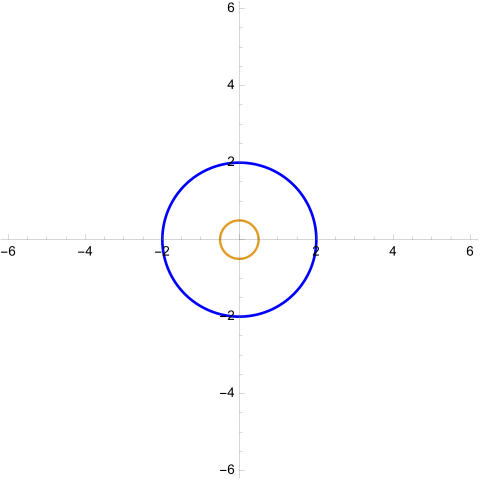
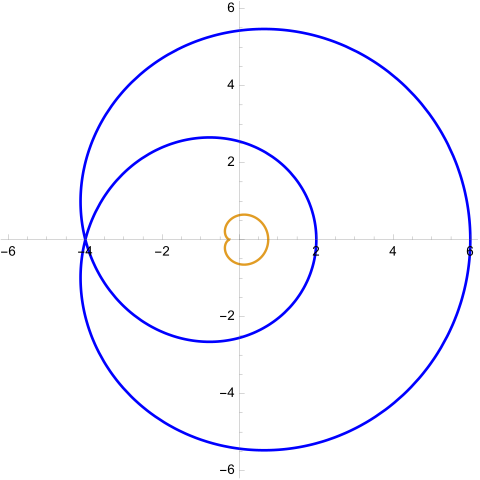
This function has simple zeroes at
Rouché’s Theorem
Definition
Let
be a bounded Jordan domain, and let with no zeroes on the boundary. Let be the zeroes of in , with orders . Then we define Immediately by the argument principle, we have that
Rouché's Theorem
Let
be a bounded Jordan domain, let , and suppose that for . Then .
Proof It suffices to show that for any boundary component
e.g. Yet another proof of the fundamental theorem of algebra:
Let