Recall the definition of a winding number in the complex plane
Transclude of The-Argument-Principle#^03d006
Kontsevich Integral
The unnormalised Kontsevich integral
of a knot is defined as: where
- the integration domain is an
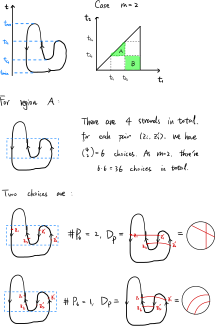
-dimensional simplex divided by the critical values into a certain number of connected components, is the set of unordered pairs of strands, is the number of decreasing strands in , is the chord diagram associated to by joining each and with a chord. The integral makes sense as “a big combo of simultaneous winding numbers” by picking the point
or along the chosen strand that you chose for , and project this point to the complex plane.
e.g. Let’s consider the hump:
Proposition
The Kontsevich integral is well defined, the coefficients of the series are finite.
Proof (Sketch) The coefficient of each
- Two strands can be arbitrarily close.
- Next to a critical point.
- Next to a critical point but don’t form an isolated chord.
(1) is resolved by restricting on tame knots, (2) and (3) are resolved by applying the 1T relation.
Lemma
The Kontsevich integral is invariant under horizontal isotopy with fixed critical points.
Lemma
The Kontsevich integral is invariant under moving critical points by finger moves.
However, it is not invariant in general if one changes the number of critical points. This is why we need to normalise the Kontsevich integral:
Normalised Kontsevich Integral
The normalised Kontsevich integral is defined as
where is the hump, is the number of critical points of .
Proposition
The normalised Kontsevich integral is a knot invariant.
Theorem
The rubber band map compose the normalised Kontsevich integral
is a universal quantum invariant.