Jordan Domains
Jordan Path, Jordan Curve, Jordan Arc
A Jordan path is a simple closed path
, that is, is a closed path which doesn’t cross itself, except at the common endpoints. A (piecewise- ) Jordan curve is the image of a Jordan path, i.e. is a Jordan curve if there exists a Jordan path such that . Such a is called a Jordan parametrization of . Specifically, A Jordan arc is the image of an injective path .
Jordan parametrisations are not unique
For example,
and both parametrize the unit circle .
Jordan Domain
A Jordan domain
is a domain such that is a disjoint union of finitely many Jordan curves.
Remark
Jordan domains can be either bounded or unbounded.
Intuitively, the integral of a holomorphic function around a Jordan curve/arc is independent of the parametrization of the curve up to the sign. This is because we can integrate the function around the curve clockwise or counterclockwise, and the result should be the same in terms of magnitude but opposite in sign.
Lemma
Let
be a Jordan curve or arc. Let and be Jordan parametrisations of . Then exactly one of the following is true:
- for all functions
holomorphic in a neighborhood of we have - for all functions
holomorphic in a neighborhood of we have
Proof It suffices to just prove the statement for Jordan arcs, as any Jordan curve can be cut into Jordan arcs. So let
Integral along a Jordan curve
Now if
is a Jordan curve with a chosen orientation, and is holomorphic in a neighborhood of , we can now write without ambiguity.
Standard Orientation
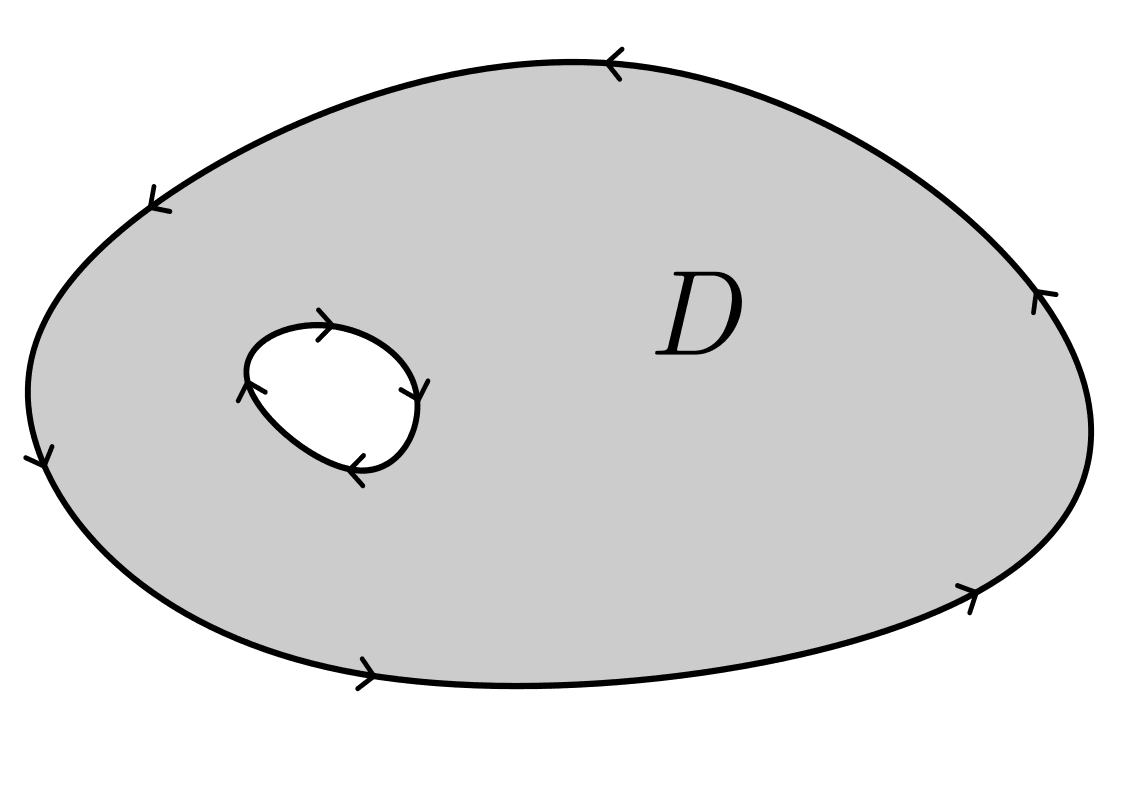
The standard orientation of the boundary of a Jordan domain
is the orientation such that the region is to the left of the curve.
Complex Green's Theorem
Cauchy Integral Theorem
Let
be a bounded Jordan domain. If , then
A picture proof of the Cauchy Integral Theorem
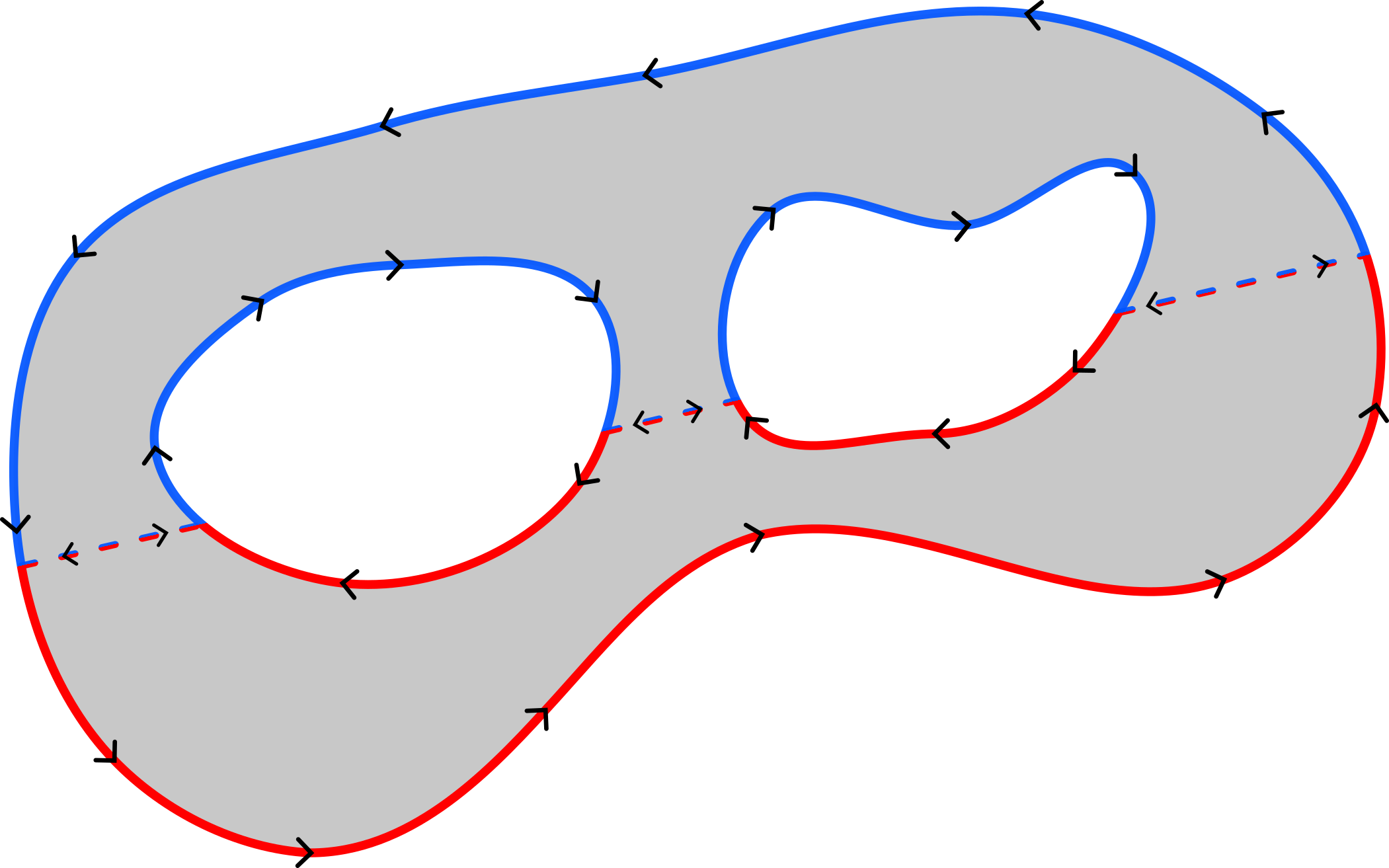
One intuitive way to understand this theorem is to think of the Jordan domain as indicated in the following figure. We add paths that connect the boundary and holes, then the integral of
around the boundary of the Jordan domain is the the sum of integrals around the blue loop and the red loops. Since is holomorphic in the region enclosed by the blue loop, the integral around the blue loop is zero. Same for the red loops. Therefore, the integral around the boundary of the Jordan domain is zero.
Proof We evaluate the the integral using Green’s theorem:
A result in complex differential geometry
We actually achieve a result in complex geometry:
Cauchy Integral Formula for Jordan Domains
Let
be a bounded Jordan domain and let . Then for all ,
Proof Let
A new insight on calculating integrals
This idea where we use the Cauchy integral theorem to reduce the integral around the boundary to an integral around a “problem point” has wide applications in mathematics and physics. Suppose
is holomorphic in a a neighborhood of . Then choosing small enough, we can cut disks out of , and get As an application, if is a polynomial, and is a bounded Jordan domain such that none of the roots of lie on the boundary of , then we can evaluate where are the roots of , and the right hand side can be calculated by Cauchy integral formula.