A path in is a continuous function . The path is called piecewise if there exists a partition such that is (i.e. differentiable with a continuous derivative) for all .
e.g. We write for the circular path given by . For , we write for the straight line path from to at constant speed.
Path Integral
The path integral of a function along a piecewise path is defined as
e.g. Let be given by . Then
Recall the definition of a reversed path:
If is a path, then the reversed path is given by .
Suppose is a domain, let , be a piecewise path in , and for . Then
Proof Let be a piecewise path, then $$\begin{aligned}\left|\int_{\gamma}f(z)\dd z\right|&=\left|\int_{a}^{b}f(\gamma(t))\gamma^{\prime}(t)\dd t\right|\&\leq \int_{a}^{b}|f(\gamma(t))||\gamma^{\prime}(t)|\dd t\&\leq M\int_{a}^{b}|\gamma^{\prime}(t)|\dd t\&=M\cdot|\gamma|\end{aligned}$$$\square$
Primitive
Primitive
If and with , then is called a primitive of on the domain .
Proposition
If and are primitives of on , then is constant.
Proof Since and are both primitives, then has derivative and is thus constant. Note that this only holds if is connected.
Proposition
If has a primitive on , and is a piecewise path, then
Proof This is simply by the fundamental theorem of calculus on with the check of Cauchy-Riemann equations, but we have to be careful because it is mixing real and complex derivatives.
e.g. Let be a domain, and suppose that and for all . Then there exists a such that for all .
Proof Since in , we have Therefore is constant, say , and thus . Since is never zero, we have . So we can write for constant some , and thus , that is .
Closed Path Integral and Primitives
Lemma
If and for every oriented triangle we have then has a primitive on .
Proof Define by We need to show that for all . Let , it suffices to show We compute The last step used the fact that the integral around the triangle with vertices is zero. Thus The second line is by ML estimate, and the last line is by continuity of . Thus for all , is a primitive of on .
Closed Path
A path is called closed if . A pair of paths are said to have common endpoints if and .
Morera's Theorem
Let , the following are equivalent:
whenever is a piecewise closed path in .
whenever and are piecewise paths with common endpoints. That is the integral is path independent.
has a primitive on .
Proof First consider the equivalence of the first two statements. Suppose property (1) holds, and are piecewise paths with common endpoints. Then is a continuous closed path . Thus Indeed, the converse is also true since we can cut any closed path into two paths with common endpoints. (3) implies (2) is obvious as if is the primitive for , we then havewhich shows that the integral is path independent.
Now we show that (2) implies (3). Fix some point , choose any piecewise path in such that and , then define This is indeed well-defined as by assumption the integral is path-independent. Fix . We are required to show that . Choose such that . Fix a path such that and . Then for , by path independence, we have Notice that has the property that the integral around any closed triangle in is zero by assumption, so we can apply the above lemma to conclude that Therefore, Since this holds for all and is arbitrary, is a primitive of on .
Local Existence of Primitives
Goursat’s Lemma
Let be a domain, and , let . Then for all oriented triangles .
Proof
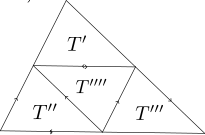
Let be an oriented triangle, and let . We wish to show that . Divide into four triangles , , , and by connecting the midpoints of each side of . Then By the triangle inequality, we have for at least one of the four triangles, i.e. .
Now we let , and be the triangle satisfying the above inequality. We continue this process to obtain a sequence of triangles such that
Claim that for some . Indeed, given , pick a sequence such that . Choose such that , then for all , , , and so . Thus is a Cauchy sequence and converges to some . For each , lies in for , and since the triangles are closed, the limit lies in . But was arbitrary, so for all , and thus . So by uniqueness of limit, is the only point in the intersection.
Now define by Since is -differentiable at , is continuous at . So we have For all , we can now compute The third step uses the fact that is a polynomial that has a primitive on , and the fourth step uses the ML estimate. It follows that In fact, given , since is continuous at , and , there exists such that for all , . Thus we can choose such that , and so Since was arbitrary, .
Theorem
Let be a disk. Then every has a primitive on .
Proof Since , , and so by Goursat’s lemma, the closed path integral of on any oriented triangle in is zero. By the previous lemma, has a primitive on .
 Let
Let