Group Structure on Loops
Fundamental Group
The fundamental group
of a topological space at a base point is the group of (path) homotopy classes of loops based at , with the multiplication of concatenation of loops, inverse being the reversed loop, and identity being the constant loop at .
Lemma
Proof For any two paths
Proposition
.
Proof The ideal is that
Remark
In fact, the distributive law holds in general: Suppose
is continuous, and are paths, then
Change of Basepoints
Proposition
Suppose
is a path from to , then the map defined by is an isomorphism.
Proof We first check that it is well-defined. Suppose 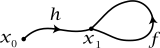 Secondly, it is a homomorphism because
Remark
Note that there is no ambiguity when we defined
. Because actually .
Fundamental groups are powerful in many (other) realms of mathematics.
- It can even be used to prove the fundamental theorem of algebra:
Proof For the sake of contradiction, suppose some non-constant polynomial
has no roots. Then for each , is a loop in based at . Now fix some large . Then is a homotopy from to . Let . Define Note that since is sufficiently large is never zero, is a valid homotopy from to . Therefore, which implies since . This contradicts the assumption that is non-constant. - We can also show the 2-dimensional Brouwer’s fixed-point theorem by the fundamental group. It states that any continuous
has a fixed point, where is the closed disk in . Proof Suppose has no fixed points. Then we can define by sending to the intersect point of and the ray from to . Note that for . Consider the inclusion , we have via some homotopy . Then via , yielding a contradiction.
Proposition
Suppose
and are topological spaces, then the fundamental group is isomorphic to .
Proof This is simply because the universal property of product spaces implies that there is a one-to-one correspondence between the loops at
e.g. We can directly deduce that the fundamental group of a torus
Proposition
Suppose
. If retracts onto , then the inclusion induced is injective. Moreover, if deformation retracts to , then is an isomorphism.
Proof Suppose
Theorem
Suppose
is a homotopy equivalence. Then is an isomorphism.
Proof
Simple Connectedness
A topological space is simply-connected if it is path-connected and its fundamental group is trivial.