Covering Spaces
Covering Space
A covering space is a continuous map
such that each point has an open neighborhood such that
is a disjoint union of open sets in : , - for each
, the restriction is a homeomorphism. Such a neighborhood
is called evenly covered by , and the set of all such open neighbourhoods is called a good cover of .
e.g.
- Let’s consider the space
covered by . 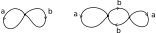 A good cover for
 can be , where: is a neighborhood of the ‘a’ loop. is a neighborhood of the ‘b’ loop. is a small neighborhood of the wedge point.  The image above shows a portion of a covering space
 of . The preimages of the open sets, for example , consist of disjoint copies of open sets where each copy is homeomorphic to . - The Empty Set: For any space
, the map is a covering space. Any open cover of is a good cover since the preimage of any set is the empty set. - The Identity Map:
is a trivial covering space. Any open cover is a good cover. - The Real Line over the Circle: The exponential map
defined by is a covering map, wrapping the real line around the circle infinitely many times. Locally, it looks like is a bunch of evenly spaced intervals mapping homeomorphically onto an arc of the circle. A concrete application of this can be seen in the proof of the fundamental group of . - The Complex Plane without the Origin: The map
given by is a covering map. This is essentially the exponential map viewed through polar coordinates. - The n-fold Cover of the Circle: For a fixed integer
, the map defined by is a covering space. This map wraps the circle around itself times. In general, one can think of this as “the sphere over real projective space”, that is, which identifies antipodal points is a covering space.
Universal Cover
A universal cover of a topological space
is a covering space with a covering map such that is simply connected.
e.g.
- The map
is a universal cover, since is simply-connected. - The universal cover of a torus
is . - For
, the map is a universal cover because is simply-connected. - The universal cover of
is an infinite 4-valent tree, which is the Cayley graph of the free group on two generators.
The Homotopy Lifting Property
Homotopy Lifting Property
Let
be a covering space. Let be a homotopy, and let be a lift of the initial map (meaning ). Then, there exists a unique lift of the entire homotopy, , such that and . The property is summarized by the following commutative diagram:
Proof Sketch The goal is to find a unique map
A key result connecting the topology of a covering space to its base space involves their fundamental groups. The homotopy lifting property leads to this fundamental proposition.
Proposition
For any covering space
, the homomorphism induced on the fundamental groups, , is injective.
Proof Sketch If a loop class
Remark
This injectivity allows us to view
as a subgroup of . The image, , consists of all loop classes in whose representative loops lift to loops in based at .
Sheets, Fibers, and Group Index
The geometric picture of a covering space having multiple “sheets” over the base space can be made precise and connected to the algebraic structure of the fundamental groups. In fact, a covering space is also an example of a fiber bundle where the fibers are discrete sets.
Lemma
For a covering space
, if the base space is connected, then the cardinality of the fiber, , is constant for all . This constant value is called the number of sheets of the cover.
Proof The function mapping a point
e.g.
- The map
from to is an -sheeted cover. - The standard covering map
is a 2-sheeted cover.
The main theorem of this section provides a beautiful correspondence between the geometry of the sheets and the algebra of group theory.
Proposition
If
and are path-connected, the number of sheets of the covering is equal to the index of the subgroup within the group .
Proof Sketch We construct a bijection
- First, define a map
that takes a loop class and maps it to the endpoint of its lift which starts at . - This map is constant on the left cosets of
. For any , the lift of terminates at the same point as the lift of , so . Therefore, induces a map . - Surjectivity: Any point
in the fiber can be reached by a path from (since is path-connected). The projection of this path gives a loop class in that maps to . - Injectivity: If two cosets map to the same point in the fiber, it means the lifts of their representative loops end at the same point. This implies that the loop
lifts to a loop in , meaning . Thus, the cosets must have been the same.
e.g. Let’s analyze the 3-sheeted cover
- The fundamental group of the base space is the free group on two generators,
. - The covering space
is a graph with fundamental group , with generators we can call . - The induced map
sends these generators to loops in . For instance, they might correspond to , , and . - The image subgroup is
. - A group-theoretic calculation shows that the index of this subgroup,
, is 3. This matches the number of sheets of the cover, confirming the theorem.