Proof Recall that the universal covering space is the set of (homotopy classes of) paths in starting at the basepoint : Any path starting at lifts to a path in starting at (the constant path), where the lifted path is defined by . The endpoint of this path is simply the class .
We can define an equivalence relation on the points of : Here, since and end at the same point, the concatenation is a well-defined loop based at , so its homotopy class is an element of .
We define the covering space as the quotient space . The projection map sends an equivalence class containing to the endpoint .
A path in starting at lifts to a loop in based at if and only if the endpoint of its lift, the equivalence class of , is the same as the start point, the equivalence class of . This occurs if and only if , which by definition means and .
Therefore, the loops in based at correspond precisely to the elements of the subgroup .
This construction establishes a fundamental link between the topology of covering spaces and the algebraic structure of the fundamental group:
There is a one-to-one correspondence between the set of isomorphism classes of based path-connected covering spaces of and the set of subgroups of .
There is a one-to-one correspondence between the set of isomorphism classes of path-connected covering spaces of (unbased) and the set of conjugacy classes of subgroups of .
Proof (1) is clear from the above proposition. To prove (2), we need to show that changing the basepoint in the cover corresponds to conjugating the subgroup .
Let be another point in the fiber over . Since is path-connected, choose a path in from to . Its projection is a loop in based at , so its class is in .
We want to compute the subgroup corresponding to the new basepoint, . The path induces an isomorphism from to by conjugation: an element is mapped to .
Applying the homomorphism gives: Letting , we can rearrange to find the new subgroup:Thus, changing the basepoint from to changes the corresponding subgroup to a conjugate subgroup. This shows that an unbased covering space corresponds to an entire conjugacy class of subgroups.
e.g. We now see an example that utilize the Galois correspondence and pure topology methods to solve a group theory problem, specifically, classify all conjugacy classes of subgroups of a group .
Consider a space with fundamental group . This group has the presentation . The PC covering spaces of correspond to the conjugacy classes of subgroups of .
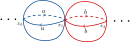
The universal cover corresponds to the trivial subgroup :
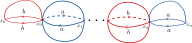
Other covering spaces correspond to larger subgroups. The following covering space with two at the endpoints and any number of spheres in the middle corresponds to :
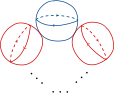
A circle of spheres corresponds to for some :
This fully describes the conjugacy classes of subgroups of .
 Consider a space
  Other covering spaces correspond to larger subgroups. The following covering space with two
  A circle of spheres corresponds to
  This fully describes the conjugacy classes of subgroups of