The Lifting Criterion
A central question in the theory of covering spaces is determining when a map
Lifting Criterion
Let
be a covering space. If is a path-connected and locally path-connected space, a continuous map can be lifted to a map if and only if the image of its induced homomorphism is a subgroup of the image of :
Proof Sketch Necessity (
- Well-definedness: If we choose a different path
from to , the loop is mapped by into . This condition guarantees that the lifts of and have the same endpoint. - Continuity: The local path-connectedness of
is essential to prove that the constructed map is continuous.
Proposition
Suppose
is a connected space and we have two lifts of a map . If there is a point such that , then the lifts are identical, i.e., .
Proof Let
Universal Property of Universal Cover
If a universal cover
of exists and is locally path-connected, then for any other connected covering space of , there exists a unique lift (covering map) . 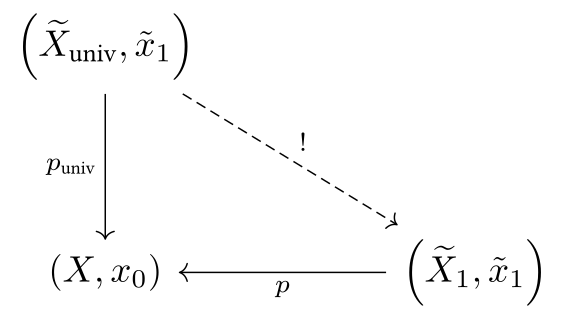
Proof Note that a universal cover is automatically path-connected and locally path-connected. So that we can apply the lifting criterion. And by the above proposition, this lifting is unique.
Morphisms of Covering Spaces
A morphism of covering spaces (covering space map) from
to is a continuous map such that . An isomorphism of covering spaces is a covering space map
for which there exists an inverse map such that and .
Uniqueness of the Universal Cover
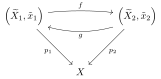
If a locally path-connected space
has two universal covers, they are isomorphic.
Proof The following diagram tells the story:
Existence of the Universal Cover
Semi-Locally Simply-Connected
A space
is semi-locally simply-connected if for any point and any open neighborhood of , there exists a smaller open neighborhood with such that the map induced by the inclusion is trivial.
Fundamental Theorem of Covering Spaces
If a space
is path-connected, locally path-connected, and semi-locally simply-connected, then a universal cover of exists.
Proof Sketch We can construct
Categorical Perspective
We can see immediately from the above that, the covering spaces of a given topological space
Also, the universal property of the universal cover can be interpreted as the universal cover is the initial object of the category of connected covering spaces of a “nice” space