Deck Transformations
Deck Transformation
A deck transformation of a covering space
is a covering space automorphism . That is, the following diagram commutes: In other words,
. The set of all deck transformations forms a group under composition, denoted or .
Remark
For a path-connected covering space
, a deck transformation is uniquely determined by its action on a single point. (ref. proposition) If for two deck transformations , then .
e.g.
- For the covering
given by , the deck transformations are homeomorphisms such that . This implies , which holds if and only if for some integer . The group of deck transformations is therefore isomorphic to the integers under addition: . - Consider
. Then , where . - Take any
, and let . i.e., is just copies of . The deck transformations are simply permutations of the copies, so , the symmetric group on letters.
Proposition
Proof By the lifting criterion, for any
Normal Covers
A key question is when the deck transformation group is “large enough” to connect any two points in the same fiber. That is, for
Normal Covering Space
is normal if for any with , there exists a deck transformation such that .
Topological Interpretation of Normal Covering Spaces
This means the covering space must “look the same” from the perspective of any two points in the fiber.
e.g. Consider the following covering space of 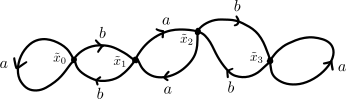 It is not a normal covering space. Observe that at
Proposition
Suppose
is PC and LPC. Let be a PC covering space (automatically LPC) with basepoint . Let and . Then the following holds:
is normal iff is a normal subgroup. , where is the normaliser of in . In particular, if is normal, then .
Remark
For
path-connected, to check if is normal, it suffices to fix some and , and check if for any , there exists a deck transformation with .
e.g. We can use this to compute the fundamental group of