The Hom Functor and Projective Modules
The cohomology groups of a space are not independent of its homology groups. The relationship is given by the Universal Coefficient Theorem:
Let
Link to originalbe a chain complex of free abelian groups and be an abelian group. Then for each , there is a short exact sequence: This sequence splits, but the splitting is not natural.
The issue here is that given a short exact sequence
Projective Module
An
-module is projective if for any surjective homomorphism of -modules and any homomorphism , there exists a lift such that . 
e.g. Free modules are projective, because we can choose
Lemma
The following hold for
-modules:
- Let
be a short exact sequence of -modules. Then for any -module , the induced sequence is exact at and . - A short exact sequence
splits if is projective. - If
is a split short exact sequence, then applying the functor results in another split short exact sequence.
Proof The proof of (1) requires showing exactness at each position.
- Exactness at
(i.e., is injective): Suppose for some . By definition, . So, . Since the original sequence is exact, is surjective, so must be the zero map. - Exactness at
: First, we show . Since the original sequence is exact at , the composition is the zero map. Therefore, . Next, we show . Suppose , which means and . This implies that . Since the original sequence is exact, . Thus, . By the first isomorphism theorem, factors through the quotient . Since is surjective, we have an isomorphism . This gives a well-defined map such that . By definition, this means , so .
Now we prove (2). The following diagram illustrates the situation, so that the splitting lemma can be applied: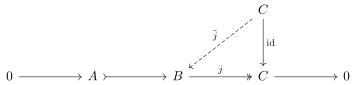 (3) follows simply from the fact that
Projective Resolutions
Projective Resolution and Ext Functor
A projective resolution of a module
is an exact sequence where each is a projective module. We denote this by . Taking a projective resolution of , remove the term, and apply the functor . This yields a cochain complex: The cohomology of this complex is denoted . is defined as the -th cohomology group .
However, this is not well-defined so far. We need to check that different projective resolutions of
Fundamental Theorem of Homological Algebra
Let
be a homomorphism of -modules. Let and be projective resolutions of and respectively. Then:
- There exists a chain map
that extends , meaning . - Any two such chain maps
and that extend are chain homotopic.
Proof The proof is constructive and proceeds by induction on the degree
- Base Case: By projectivity of
, we can lift the map to a map such that : 
- Inductive Step: Assuming
have been constructed to form a chain map up to that degree, we construct as follows: 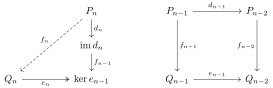 Since the RHS diagram commutes, we can conclude that
 . So the projectivity implies the LHS diagram commutes, completing the inductive step.
Now suppose both 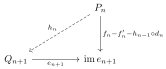
Corollary
Let
and be two projective resolutions of the same module . Then there is a chain homotopy equivalence between them. Consequently, for any module ,
Proof By the above theorem, we can find chain maps  The composition
The Ext Functor
The previous result shows that the cohomology groups
Proposition
We have the following properties of the Ext functor:
. for .
Classification of Extensions
The Ext functor gets its name from its connection to extensions of modules. For
, the group provides a classification of the collection of all short exact sequences of the form up to a natural equivalence. These sequences are called “extensions” of by . For the ring of integers , it is common to abbreviate to simply .