Functoriality
Functor
A (covariant) functor between categories
and is a mapping of objects to objects and morphisms to morphisms such that for all -objects and :
A contravariant functor is a similar mapping
, but reverses the direction of morphisms:
, , . Equivalently, a contravariant functor is a (covariant) functor from the opposite category
to .
e.g.
- Every category
has an identity functor . - The mapping sends any vector space
to its dual space , and any linear map to its dual map (i.e. the pullback) is a contravariant functor from the category of vector spaces to itself. - The functor that sends each finite set to its power set and each function to the corresponding function on the power sets is a contravariant functor.
The Category of Small Categories
We now have another example of a category, namely
, the category of all small categories and corresponding functors.
Injective & Surjective on Objects
A functor
is said to be injective on objects if the object part is injective, it is surjective on objects if is surjective. Similarly, is injective or surjective on morphisms if the morphism part is injective or surjective.
Faithful & Full Functor
Suppose
, are locally-small categories. A functor is faithful if for all , the map is injective. It is full if is surjective.
Embedding
A functor
is called an embedding if it is full, faithful, and injective on objects.
Full Subcategory
A full subcategory
consists of some objects of and all of the morphisms between them.
Representable Structure
Representable Functor
Let
be a locally-small category, we have the representable functors: for all objects .
Generator
A generator for category
is an object has the property that for any objects and and morphisms , if then there is an arrow such that . That is, the arrows in the category are distinguished by their effect on generalized elements based at .
Contravariant Representable Functors
Let
be a locally small category, we have the contravariant representable functors: taking to by for .
Naturality
Natural Transformation
Given categories
and and covariant functors , a natural transformation consists of:
- morphisms
, is called the component of at . - and components must be such that for every morphism
in we have:
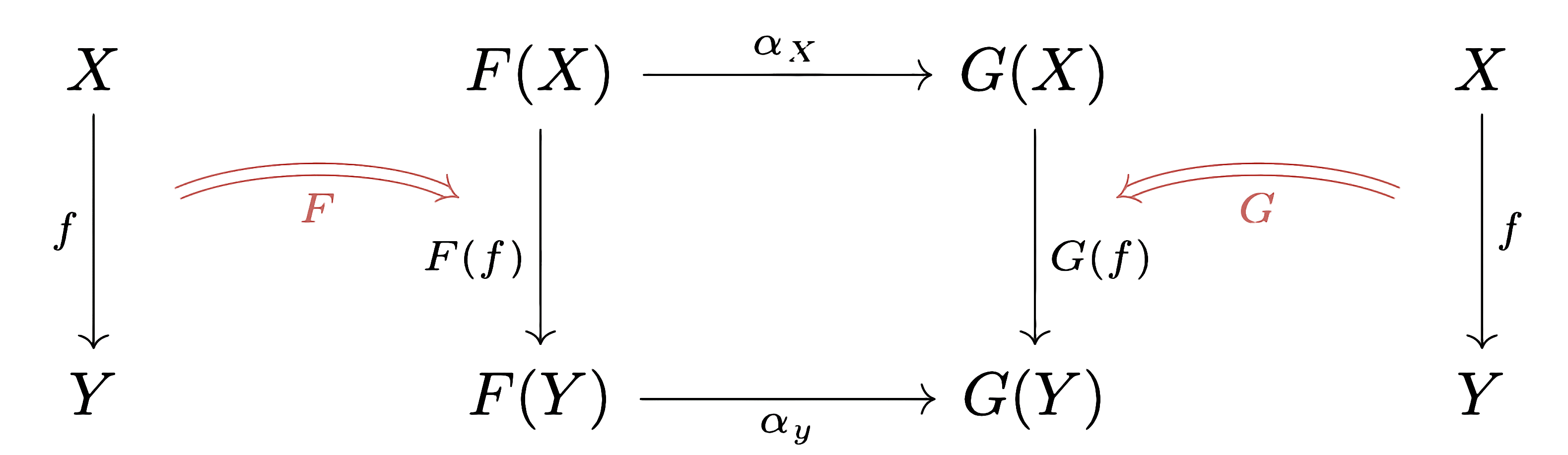
Vertical Composition
Suppose
and are natural transformations between parallel functors . Then there is a natural transformation whose components Such is called the vertical composition of and .
Proof Naturality of 
Natural Isomorphism
A natural isomorphism is a natural transformation
in which every component is an isomorphism. In this case, the natural isomorphism may be depicted as
Functor Category
Define the category of functors
having functors as objects and natural transformations as arrows. And for each functor object , the natural transformation has components And the composite natural transformation of and is the vertical composition.
Proposition
If categories
and are small, then is again a small category, but if and are locally small, then need not be. This is only guaranteed if is locally small and is small.
Lemma
A natural transformation is a natural isomorphism if and only if it forms an isomorphism in the functor category.
Lemma
Lemma Given locally small categories
, , and , a map of arrows and objects, forms a functor iff
is functorial in each argument: and are functors for all and . satisfies the following interchange law. Given and , .
Proposition
Prop
is cartesian closed, with the exponentials . Proof
Equivalence of Categories
Equivalent Categories
An equivalence of categories consists of a pair of functors
and and a pair of natural isomorphisms In this situation, the functor is called a pseudo-inverse of . The categories and are then said to be equivalent, written .
Proposition
Prop The following conditions on a functor
are equivalent:
is part of an equivalence of categories. is full and faithful and “essentially surjective” on objects: for every there is some such that .