Graded Algebra and Filtered Algebra
Graded Algebra
 Suppose
 Degree Completed Graded Algebra
A degree completed graded algebra is a degree completion of a graded algebra
by taking the inverse limit.
Direct sum vs. Direct product
As vector spaces, the only difference is that the former consists of finite linear combinations of homogeneous elements, whilst in the latter, we also have infinite linear combinations: think power series versus polynomials.
Warning
We will allow a graded algebra to be either a direct sum, or a direct product, and will restrict to graded algebras which are direct products (degree completed graded algebra), and just call it graded algebra, as this is the most common case in knot theory.
e.g. Suppose
Remark
Graded algebra is good in the sense that:
- degree is a notion of complexity (of computation).
- easy to deal with computation (degree by degree or up to degree
) - can apply induction on degree
Filtered Algebra
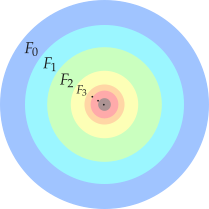 Hence we have a
 Remark
This is not as good as graded algebra because, for instance, though
, implies , as , could actually be in .
e.g. Any graded algebra is a filtered algebra, since we can take
The Associated Graded Functor
Associated Graded Algebra
Given a filtered algebra
, we can define a graded algebra by taking . We denote this graded algebra as , and define the multiplication of components by and extend to all elements of via Cauchy product formula: for all . 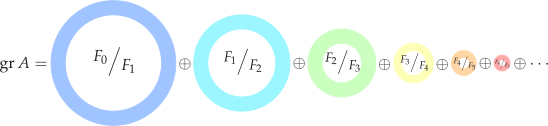
Proposition
forms a functor from to .
Proof Suppose
Proposition
A quotient of a graded algebra is graded precisely when the ideal is homogeneous (i.e.,
). A quotient of a filtered algebra is always filtered.
The Pro-Unipotent Filtration
In this section we define a famous filtration on the group algebra
Augmentation Map
The augmentation map
is defined by sending each group element to : where and .
Proof The augmentation map is clearly an algebra homomorphism because
Augmentation Ideal
An augmentation ideal
is the kernel of the augmentation map. That is, the set of elements of whose coefficients sum to zero.
Proposition
The product of augmentation ideal for
times is an ideal of the algebra. i.e. .
Proof For all
Pro-unipotent Filtration
The pro-unipotent (a.k.a
-adic) filtration of a an algebra is the sequence of ideals: where is the product of augmentation ideal for times, that is the ideal generated by products of elements of .
e.g. Consider