Connectedness
Connectedness
A topological space
is called connected if there do not exist two disjoint nonempty open sets and such that .
e.g.
- The set
of rational numbers in the standard Euclidean topology is not connected because with and . Note that this also means that a subspace of a connected space need not be connected. - Let
be endowed with the standard Euclidean topology. A set is connected if and only if is an interval.
Theorem
Let
and be topological spaces. If is continuous and is connected, then is connected, i.e. the continuous image of a connected set is connected.
Proof We prove the contrapositive. Suppose
Corollary
Every continuous map
from a connected topological space to a discrete topological space is constant.
Proof This is because the only connected subsets of a discrete space are the singletons.
Intermediate Value Theorem
Let
be a connected topological space and a continuous function, where is endowed with the standard topology. If takes the values and , then takes all the values between and .
Proof By the given conditions,
Remark
This is a generalization of the classical intermediate value theorem in real analysis.
Lemma
If
is connected and , then is connected. In particular, the closure of a connected set is connected.
Proof Since
Proposition
A topological space is connected iff the only both open and closed sets are the empty set and itself.
Proof Suppose
Path Connectedness
Path
Let
be a topological space. A path in joining two points is a continuous function such that and .
If the start point and end point coincide, we call it a loop.
Path Connectedness
A topological space
is called path connected if for every pair of points can be joined by a path in .
Theorem
A path connected topological space is connected. In general, connected space is not necessarily path-connected.
Proof If
e.g.
- Any convex set in a topological vector space in
is path connected; is path connected for ; - The topologist’s sine curve
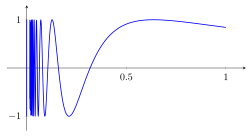
is connected but not path connected:
Theorem
Continuous image of a path-connected space is also path-connected.
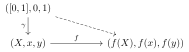
Proof This is clear because of the following diagram:
Proposition
If
is an open set in , then is connected if and only if is path connected.
Proof It suffices to show that if

Now we show that
Proposition
The following holds:
- Every quotient of a (path) connected space is (path) connected;
- The union of a family of (path) connected subspaces of
that have a point in common is (path) connected; - Any product of (path) connected spaces is (path) connected.
Proof (1) is immediate from the theorem; For (2), path connectedness is clear, and we will only prove that it is connectedness here. Suppose
For (3), path connectedness is clear by the universal property, and we will only prove connectedness. We will first show that the product of two thus any finite connected spaces is connected, and then extend the result to the infinite case. In fact, fix some
Components
Components
A (path-) component of a topological space
is a maximal (path-) connected subspace of .
Proposition
The following holds for a topological space
:
- The (path) components form a partition of
; - Any (path) connected subset is contained in a unique (path) component;
- Each path component is contained in a single component and each component is a disjoint union of path components.
Proof By (2) of the proposition, we know that whenever (path) components
Proposition
Components of a topological space are always closed.
Proof This is a direct consequence of the lemma, because the closure of a component is also connected, so the maximality implies that the component itself has to be closed.
Remark
Note that in general components need not be open. For example, the components of
(with the subspace topology from ) are singleton sets, which are not open.
More importantly, path components need not be open nor closed. Think about the topologist’s sine curve, one of the path component is open, and the other is closed.
Locally (Path) Connectedness
Sometimes being (path) connected globally is not enough. We can still have “bad” and “wild” spaces that are separated locally. We have the following variation notion on connectedness:
Locally (Path) Connected
A topological space
is locally (path)-connected if for any point and any open neighborhood of , there exists a (path) connected open neighborhood containing .
Equivalently, this meansadmits a basis of (path) connected open sets.
In general, there are no implications between the local and global versions. Here are some examples:
e.g.
- Consider
. Clearly it is path connected but not locally path-connected because for any point , any open neighborhood of contains points of the form for , which cannot be connected by a path in ; is locally connected but not connected; - The topologist’s sine curve is connected but not locally connected.
Similar to the global version, local path-connectedness is also stronger than local connectedness:
Proposition
If
is locally path connected, then it is locally connected.
Proof Immediate from the basis characterization of local (path-) connectedness and the fact that every path connected space is connected.
Proposition
If
is locally (path-) connected, then every open subset is locally (path-) connected. Moreover, every (path-) component is open.
Proof If
We now prove that every component is open. Suppose
The following proposition and corollary give a sufficient condition for path-connectedness being the same as connectedness. It can explain the equivalence of path-connectedness and connectedness on $\R^{n}$ in a clean way.
Proposition
Suppose
is locally path-connected, then the path components of coincide with the components of .
Proof Since every component is a partition of path components, it suffices to show that every component is path-connected. Suppose
Corollary
If a topological space is locally path-connected, then it is connected iff it is path-connected.