Subspaces
Subspace Topology
If
is a topological space and , then the subspace topology on is We call a topological subspace of .
e.g.
- If we consider
as a subspace of then the open sets in consist of all sets where is an open subset of . In particular, is open in the subspace for every ; - Suppose that
is a metric space with corresponding topology . If then subspace topology on corresponds to the topology on that arises from the metric space .
Proposition
Closed subset in closed subspace is closed in the original topological space.
Proof Let
Universal Property of the Subspace Topology
Let
be a topological space and a subspace (with the subspace topology). Then
- The inclusion map
is continuous; - For any topological space
, a map is continuous iff the composite is continuous; - The subspace topology is the unique topology on
with this property. 
Proof The continuity of the inclusion map follows from 2. For 2, suppose
Corollary
Suppose
is continuous. Then
- The restriction
is continuous for any subspace ; - If
is a subspace of that contains the image , then is continuous; - If
is a subspace of , then is continuous.
Proof This is obvious from the above theorem.
Product Spaces
Product Topology
Suppose that
is a family of topological spaces. Then the product topology on their Cartesian product is the topology with basis
We callthe product topology on .
Remark
Note that
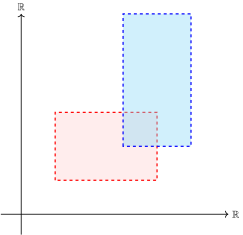
may not be a topology on . For example, on , since every open set in is a disjoint union of open intervals, sets in the Cartesian product of the standard topologies are disjoint union of rectangles. But clearly, the union of two rectangles may not be a rectangle.
Moreover, the product topology is independent of choice of the bases. This is because ifand are bases for and , respectively, then the topology generated by is the same as the topology generated by . (This is a direct result of proposition)
Lemma
The product topology is generated by the subbasis
where is the projection map. In particular, it is the coarsest topology on such that all projection maps are continuous.
Proof Suppose
Universal Property of Product Topology
The product topological space is the product in the category
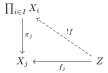
, i.e. for any topological space and a family of continuous maps , there exists a unique continuous map such that for all , where is the projection map.
Moreover,is the unique space with this property, up to homeomorphism.
Proof We will show that each
Disjoint Union Topology
Disjoint Union Topology
Suppose that
is a family of topological spaces. Then the disjoint union topology or corproduct topology on their disjoint union is defined by declaring that is open iff is open in for each .
Universal Property of Disjoint Union Topology
The disjoint union of topological spaces is the coproduct in the category
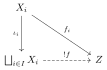
, i.e. for any topological space and a family of continuous maps , there exists a unique continuous map such that for all , where is the inclusion map.
Quotient Topology
Quotient Topology
Suppose
is a topological space and is a set. is surjective, then the quotient toplogy is a topology on by declaring that is open iff is open in . Such is called a quotient topology.
Universal Property of Quotient Topology
The quotient map
has the following universal property (i.e., it is the coequalizer in ): For any topological space , a map is continuous iff the composite is continuous.
Conversely, for any continuous mapsuch that whenever , there exists a unique continuous map such that .

Corollary
If the two quotient maps
and have the same identification, that is, for all , then there is a unique homeomorphism such that .
Proof This is obvious from the universal property. In fact, coequalizers are unique up to isomorphism in any category.
e.g.
- Consider the unit interval
, then , and ; - The torus
; - Real projective space
is the set of one dimensional subspaces in equipped with the quotient topology induced by the map sending any to its span. - For topological space
and , we can collapse to a point to build space . i.e., introduce an equivalence relation iff or . - The cone of a topological space
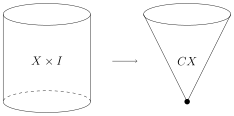
is the quotient space , where is the unit interval. The cone of is homeomorphic to .
Proposition
The composition of two quotient maps is a quotient map; If
is a quotient map, then is a quotient map.
Proposition
An injective quotient map is a homeomorphism.
Proposition
A continuous surjective map
is a quotient map iff it takes saturated open subsets to open subsets (or saturated closed subsets to closed subsets).
Corollary
Note that quotient spaces do not behave well with respect to most topological properties. Neither Hausdorffness, nor 2nd countability automatically pass to quotient spaces. It is generally hard to prove a quotient space is Hausdorff. However, for open maps, it’s a little easier:
Proposition
Suppose
is an open quotient map then is Hausdorff if and only if the set is closed in .
Proof We denote
Attaching Spaces
Attaching Space
Let
be a closed subspace of and a continuous map. The attaching space formed by attaching to along is the quotient
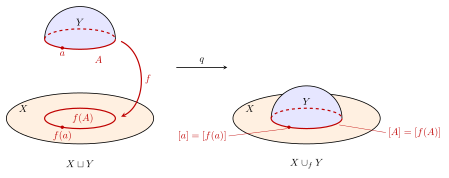
Remark
If
, this is just the disjoint union .
Initial and Final Topologies
From the definition of the above topologies, we can see that there is a general pattern: the product topology is the coarsest topology that makes all projection maps continuous, the disjoint union topology is the finest topology that makes all inclusion maps continuous, and the quotient topology is the finest topology that makes a given surjective map continuous. This leads us to the concepts of initial and final topologies.
In fact, for those who are familiar with category theory, the initial and final topologies are just the limit and colimit in the category of topological spaces, and all the above topologies are special cases of initial and final topologies, just like products, coproducts, equalizers and coequalizers are special cases of limits and colimits.
Initial and Final Topologies
Suppose
is a set, and is a family of topological spaces with maps for each . The initial topology on induced by the maps is the coarsest topology on that makes all the maps continuous. That is, the initial topology is generated by the subbasis
Dually, ifis a family of topological spaces with maps for each , the final topology on induced by the maps is the finest topology on that makes all the maps continuous.