Cover and Subcover
A cover of a set
is collection of sets whose union contains : A subcover of a cover is a subset of whose elements still cover . A cover is open if all its elements are open.
e.g.
Compactness
A topological space
is compact if every open cover of has a finite subcover. A subset of is compact if every open cover of by subsets of has a finite subcover. This is the same as being compact with the subspace topology.
e.g.
is not compact, is an open cover with no finite subcover; is not compact, has no finite subcover; with the box topology is not compact. In fact, any discrete infinite space is not compact, since the cover of singletons has no finite subcover.
Lemma
If
is a topological space and then is compact in the if and only if is compact in the subspace topology on .
Continuous Image of a Compact Set is Compact
Let
and be topological spaces. If is compact and is continuous, then is compact.
Extreme Value Theorem
Let
be a compact topological space and continuous, where is endowed with the standard topology. Then achieves its maximum and minimum value on .
Heine–Borel Theorem
Any closed interval
is a compact subset of . More generally, a subset of is compact if and only if, it is bounded and closed.
Proof
Theorem
Let
be a compact topological space and a closed subspace of . Then is compact.
Proof Let
Corollary
Any intersection of a compact set with a closed set is compact.
Proof Suppose
Tube Lemma
Let
be any topological space and be a compact space. If and is an open set containing , then there is an open neighborhood of so that .
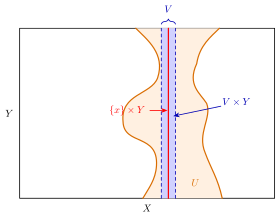
Proof
Corollary
Any finite disjoint union, quotient, or finite product of compact spaces is compact.
Proof Finite disjoint unions of compact spaces are compact since any open cover of the union is an open cover of each component; The quotient of a compact space is compact since the continuous image of any compact space is compact; To show finite product of compact spaces is compact, it suffices to only consider the product of two compact spaces, say
Tychonoff’s Theorem
We have just showed that any finite product of compact spaces is compact. However, this is true even for infinite products if we assume the axiom of choice. This is known as Tychonoff’s theorem.
Tychonoff's Theorem
The product of any collection of compact topological spaces is compact with respect to the product topology.
To prove this theorem, we need an alternative characterization of compactness in terms of closed sets:
Finite Intersection Property
A collection of subsets of a set
is said to have the finite intersection property (FIP) if the intersection of any finite subcollection is nonempty.
Proposition
A topological space
is compact if and only if every collection of closed subsets of with the finite intersection property has a nonempty intersection.
Proof We prove that
Lindelöf Spaces
There is a slightly weaker notion of compactness called Lindelöf spaces, which is defined as follows:
Lindelöf Space
A topological space
is called a Lindelöf space if every open cover of has a countable subcover.
Proposition
A second-countable space is Lindelöf.
Proof Let
Remark
The proof above utilized countable axiom of choice.
Sequential and Limit Point Compactness
Limit Point Compactness
A topological space
is called limit point compact if every infinite subset of has a limit point in .
Lemma
Every compact space is limit point compact.
Proof Suppose
Sequential Compactness
Let
be a topological space and . We say that is sequentially compact if every sequence in has a subsequence converges to a point in .
Lemma
Suppose
is limit point compact, first-countable and Hausdorff, then is sequentially compact.
Proof Suppose
Remark
Here, we utilized Hausdorffness to construct a subsequence (i.e., we need to ensure that the subindex
for all ), and first-countability to ensure the subsequence converges.
Lemma
If
is sequentially compact, and second-countable, then is compact.
Proof Since
In summary, the above lemmas tell us immediately that
Theorem
Compactness, limit point compactness, and sequential compactness are equivalent for metric spaces and second-countable Hausdorff spaces.
Local Compactness
Precompactness
A subset
of a topological space is precompact if its closure is compact.
Local Compactness
A topological space
is locally compact if every point has a compact neighbourhood.