Singular Homology
Recall that a
Singular Chain Complex
For a topological space
, the singular chain complex is a sequence of abelian groups and homomorphisms , called boundary maps:
- Singular
-chains is the free abelian group generated by all continuous maps , where is the standard n-simplex. - The boundary map
is defined on a generator by: where is the restriction of to the -th face of . A key property is that
.
Singular Homology
An element of
is called an -cycle, and an element of is called an -boundary. The -th singular homology group of is the quotient group:
Chain Map
A chain map between two chain complexes
and is a sequence of homomorphisms such that the following diagram commutes: 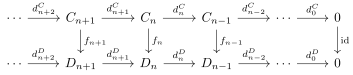
Proposition
A continuous map
induces a chain map by composition , which in turn induces a homomorphism on homology groups by .
Proof For each
Homotopy Invariance
It turns out that if two topological spaces are homotopic, then their homologies are isomorphic. To show this, we need the notion of a chain homotopy:
Chain Homotopy
Let
be two chain maps. A chain homotopy between and is a sequence of homomorphisms such that for all :
Proposition
A homotopy
from to induces a chain homotopy from to .
Proof Sketch Given a singular
Homotopy Invariance
If two maps
are homotopic, then they induce the same homomorphism on homology groups:
Proof Suppose
Corollary
If
and are homotopy equivalent, then their homology groups are isomorphic:
Homology of a Point
A simple but important calculation is the homology of a single point space, denoted
Homology of a Point
The homology groups of a point are:
Proof For any