Reduced Homology and Path Components
Recall that the singular homology of a point is:
The homology groups of a point are:
Link to original
It is often convenient to modify the definition of homology so that a point has trivial homology in all dimensions. This leads to reduced homology.
Reduced Homology
The reduced singular homology groups, denoted
, are the homology groups of the augmented chain complex: where the augmentation map is defined by .
Remark
This definition makes sense, since
can be recognized as the empty set, and there is a unique map from the empty set to any space, so .
e.g. For a point, the augmentation map
Proposition
Let
be a non-empty, path-connected space. Then and .
Proof The map 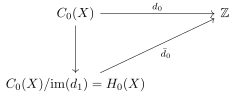 From the above diagram, we know that the reduced homology
Homology of Disjoint Unions
Direct Sum of Chain Complexes
If
and are chain complexes, then their direct sum is the chain complex with , and the boundary map defined by .
Lemma
The following properties hold:
, , moreover, .
Corollary
If a space
is a disjoint union of its path components , then the homology groups are direct sums: In particular, for any space , counts the number of path-components of .