In the integrability theorem, we demonstrated that every projective representation of
Theorem
does not admit a complexification.
Proof We can see this by contradiction. If there were a complex Lie group
The Semigroup of Annuli
Semigroup of Annuli
The semigroup of annuli, denoted
, consists of equivalence classes of triples where is an annulus-like surface, and , are orientation preserving diffeomorphic parametrisations of the outer and inner boundaries of , respectively.
Two annuliand are considered equivalent if there exists a biholomorphic such that the following diagram commutes: 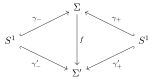
We call equivalence classes of annuli annulus classes. The semigroup operation is defined on annulus classes by welding corresponding annulus-like surfaces along their boundaries. Concretely, given two annulus classes
and , their product is obtained by identifying the outer boundary of with the inner boundary of via the parametrisations and . The resulting annulus is , and we shall simply denote it by .
We denote the union ofand as .
Remark
What we really care about here is not the plain annuli, but the rigged annuli that including the parametrisation information of the boundaries (riggings). If you forget the boundary parametrisations and look only at conformal isomorphism classes of annuli, then every annulus is conformally equivalent to a round annulus
, and its conformal type is determined by a single real number .
So far, we have not proved that this welding operation is well defined: namely, that the welded surface carries a complex structure and that the operation is independent of the choice of representative. Clearly, the welding of two annuli remains an annulus topologically, we need to verify that the resulting annulus can be given a complex structure. In fact, since this is a local problem, it suffices to only consider the welding of two disks under some attaching map
Proposition
is an complex Fréchet manifold, inheriting the complex structure from .
Proof It suffices to show that the inclusion
Involution on
There is an involution
that turns an annulus inside out, so that the incoming and outgoing circles are exchanged, but their parametrizations remain the same
The Standard Representative
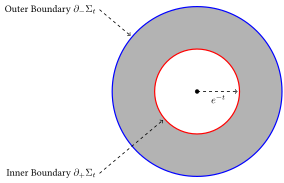
Once we checked that
Alternative Realizations of
Proposition
Every annulus can be uniquely (up to some normalization) identified as a tuple
, where is a Riemann surface conformally equivalent to the Riemann sphere, and and are holomorphic embeddings of the unit disk and .
Proof This is a direct result of the conformal welding. For each annulus
For more alternative realizations of
References
[@neretinHOLOMORPHICEXTENSIONSREPRESENTATIONS1990]