The Seifert-van Kampen Theorem
van Kampen Theorem
Let
be a topological space, with . Suppose each is open and path-connected.
- If each intersection
is path-connected for all , then the homomorphism induced by the inclusion maps is surjective. - If, additionally, each triple intersection
is path-connected for all , then the kernel of is the normal subgroup generated by all elements of the form for . In this case,
induces an isomorphism:
The path-connectedness of the intersections is a crucial hypothesis. If it fails, the theorem does not apply and can give incorrect results:
e.g. Cover the circle
- We have
and since and are contractible. - A naive application of the theorem might suggest
, which is false. - The issue is that the intersection
consists of two disjoint arcs and is therefore not path-connected. Condition (1) of the theorem is not met.
e.g. Let
- Each of
deformation retracts to a circle, so . - The pairwise intersections
, , and are contractible, thus path-connected. - Van Kampen part (1) would suggest
is a quotient of . - However, the space
is the wedge sum , so its fundamental group is . - The issue here is that the triple intersection
is not path-connected, so condition (2) does not apply.
We will see right applications of the van Kampen after introducing the wedge sum.
The “Good Point” Condition for Infinite Unions
Wedge Sum
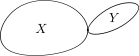
The wedge sum of two topological spaces
and at points and is the topological space .
For the theorem to extend to infinite unions of closed sets, a local condition on the basepoint is often required.
Good Point
A point
is called good if has an open neighborhood that deformation retracts to .
e.g. Consider the space

Fundamental Group of a Wedge Sum
Suppose
is a good point for each . Then the fundamental group of the wedge sum is the free product of the fundamental groups of the components:
Proof Sketch One can “fatten” each space
Applications: Complements of Links in
The Torus
We can
Complement of a Single Circle
Let
Another way is to note that
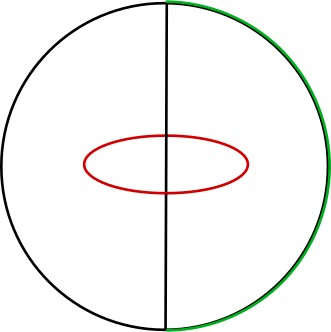
Now let
Complement of Unlinked Circles
Let
This group is non-abelian. A loop winding around the first circle does not commute with a loop winding around the second. The space has the homotopy type of
Complement of Linked Circles (Hopf Link)
Let
The fundamental group is the direct product (or sum) of two copies of
This group is abelian. The linking of the circles forces the generators of the fundamental group to commute. This space is claimed to be homotopy equivalent to