Rings
Ring
A ring
is a set equipped with two laws of composition and , called addition and multiplication, satisfying the following axioms:
is an abelian group with identity , called zero; - The multiplication is associative:
for all ; - Distributivity:
and for all . If
has an identity with respect to multiplication, we say that is unital.
A ringis commutative if the multiplication is commutative.
e.g.
is the trivial ring with , it is sometimes called the zero ring; - The integers
is a commutative unital ring, any is a commutative unital ring; - The set of 2×2 matrices with real entries
is a non-commutative unital ring.
Subring
A subset
in a ring is called a subring if is closed under addition, subtraction, multiplication and contains (if is unital).
e.g.
- The trivial ring is not a subring of any other nontrivial rings, even though itself is a ring. The point is
Unit
An element of a ring
is called a unit if it is invertible with respect to multiplication. The set of invertible elements is a group called the the group of units in and denotes .
Proposition
For any (non-unital) ring
, is a unital ring with multiplicative identity under the multiplication
where for any, is a shorthand for ( times) if , if , and if . (any abelian group is a $\Z$-module)
Proof This is easy to check.
From the above proposition, we can see that any ring can be enlarged into a unital ring. So we can just focus on unital rings most of the time. From now on,
Attention
We shall sometimes just call commutative unital rings “rings”, and emphasize the other cases when necessary.
Field and Domain
Zero Divisor & Integral Domain
A zero divisor in a ring
is a non-zero element such that for some non-zero . A ring without zero divisors is called an integral domain. In other words, an integral domain is a ring in which the product of any two non-zero elements is non-zero.
Cancellation Law
An integral domain
satisfies the cancellation law: if and then .
Proof Suppose
Field
A field is a ring
in which and every non-zero element is invertible, that is .
e.g. The rational numbers
Proposition
Any field is an integral domain.
Proof Suppose
Proposition
is a field if and only if is a prime.
Proof Suppose
Proposition
Every finite integral domain is a field.
Proof Suppose
Given any integral domain, we can construct the smallest field containing it, called the fraction field:
The Field of Fractions
Suppose
is an integral domain. Consider equip with the following relation:
This is an equivalence relation. Letdenote the quotient. We denote the equivalence classes by .
Universal Property of the Field of Fractions
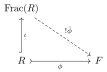
is the smallest field containing . More precisely, for any field and any injective ring homomorphism , there exists a unique field homomorphism such that the following diagram commute:
Proof
In general, if a ring
Ordered Field
Ordered Field
An ordered field is a field
along with a subset of , called the positive subset, with the following properties:
- if
, then or or . - if
, then . - if
, then and . Equivalently, a field
together with a total order on is an ordered field if the order satisfies the following properties for all :
. .
Proposition
The positive subset
is closed under multiplicative inverse. i.e. Suppose is an ordered field with positive subset . Then and for all .