Initial and Terminal
Initial and Terminal Objects
In a category
, an object is initial or coterminal if there is a unique morphism for all . An object is terminal if there is a unique morphism for all .
If an object is both initial and terminal, it is called a zero object or null object. A pointed category is one with a zero object, or more generally, isomorphic initial and terminal objects.
e.g.
- In
the empty set is initial, and any singleton set is terminal. - In
the category (no objects and no arrows) is initial, and the category (one object and identity arrow) is terminal. - In
, the one element group is both initial and terminal, hence a zero object. - In
, is the initial object, and the trivial ring is the terminal object. - In
, an object is initial iff it is the least element, and terminal iff it is the greatest element. - For any category
and any object , the identity arrow is a terminal object in and an initial object in .
Proposition
Initial and terminal objects are unique up to isomorphism if exists.
Proof Suppose
Strict Initial Object
A strict initial object
is one for which every morphism into is an isomorphism.
Pointed Category
Zero Morphism
Suppose
is a pointed category with a zero object (up to isomorphism). For any objects , we can define a zero morphism as the composition .
Proposition
In a pointed category, composition of a morphism with a zero morphism is always a zero morphism.
Proof The following diagram commutes:

In a pointed category, we can define the notion of kernel and cokernel:
Kernel & Cokernel
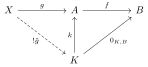
In a category with a zero object, a kernel of a morphism
is a morphism that is an equalizer of and . That is, the following diagram commutes:
Dually, cokernel ofis a morphism that is a coequalizer of and .
Generalized Elements
In a broad, non-technical sense, an “element” is a “component” or “basic part” of a more substantial whole. Ordinary or global elements of a set are simply the points of that set, and hence sufficiently capture this broad notion of “element” in
Global Element
In any category
with a terminal object , the morphisms are called global elements, points or constants of .
Generalized Element
The morphism
is called a generalized element or -valued point of , with stage of definition given by .
e.g. In
Proposition
In any category
, and for any morphisms , we always have if and only if for all , it holds that .
Proof