Groups in a Category
Group Object
Let
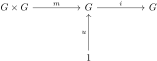
be a category with finite products. A group object in consists of objects and arrows as:
satisfying the following conditions:
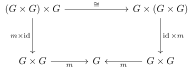
is associative, that is the following commutes:
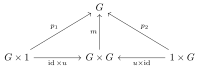
whereis the canonical associativity isomorphism for products. is a unit for , that is both triangles in the following commute:
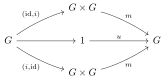
is an inverse with respect to , that is both sides of this commute:
Homomorphism
A morphism
of groups in is called a homomorphism if
preserves preserves preserves
e.g. The idea of a group in a category captures the familiar notion of a group with additional structure:
- A group in the usual sense is a group object in the category
. - A topological group is a group in
, the category of topological spaces. - A group object in
is an abelian group, because the multiplication map is a homomorphism of groups if and only if is abelian.
Category of Groups
Prop If 
Proof
Groups as Categories
Prop A group is a category with one object, in which every arrow is an isomorphism.
Def Congruence
A congruence on a category
implies and . implies for all morphisms and , where and .
Prop The intersection of a family of congruences is a congruence.
Def Congruence Category
Let
Def Quotient Category
We define the quotient category
. . - The morphisms have the form
where . , and .
Prop There is an evident quotient functor

Proof
Def Kernel of Functor
Any functor
Thrm For all functor

Proof
Corollary Every functor

where
on Hom-sets.
Finitely Presented Categories
e.g. The category with two uniquely isomorphic objects is not free on any graph, since it’s finite, but has loops. But it is finitely presented with graph

and relations