Natural Transformation
Natural Transformation
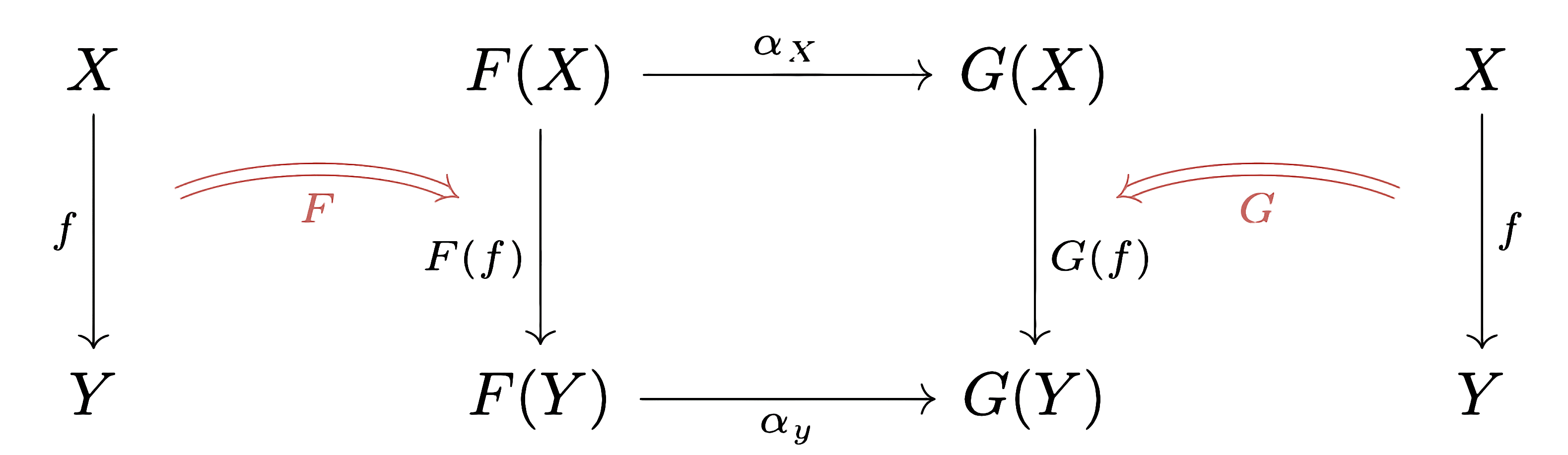
Given categories
and and covariant functors , a natural transformation consists of:
- morphisms
, is called the component of at . - and components must be such that for every morphism
in we have:
Vertical Composition
Suppose
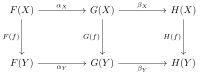
and are natural transformations between parallel functors . Then there is a natural transformation whose components Such is called the vertical composition of and .
Remark
We shall check the vertical composition is a natural transformation. Naturality of
and implies that for any in the domain category , each square, and thus also the composite rectangle, commutes:
Natural Isomorphism
A natural isomorphism is a natural transformation
in which every component is an isomorphism. In this case, the natural isomorphism may be depicted as .
The Functor Category
Functor Category
Define the category of functors
having functors as objects and natural transformations as arrows. And for each functor object , the natural transformation has components And the composite natural transformation of and is the vertical composition.
Proposition
If categories
and are small, then is again a small category, but if and are locally small, then need not be. This is only guaranteed if is locally small and is small.
Proposition
A natural transformation is a natural isomorphism if and only if it forms an isomorphism in the functor category.
Proof If
Lemma
Given locally small categories
, , and , a map of arrows and objects, forms a functor iff
is functorial in each argument: and are functors for all and . satisfies the following interchange law. Given and , .
Proposition
is cartesian closed, with the exponentials .
Horizontal Composition
Horizontal Composition
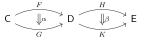
Given a pair of natural transformation
and as indicated in the diagram:
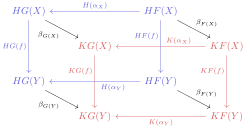
there is a natural transformationwhose component at is defined as
Remark
is a well-defined natural transformation by observing the following commutative diagram:
Middle Four Interchange
Given functors and natural transformations
the natural transformationdefined by first composing vertically and then composing horizontally equals the natural transformation defined by first composing horizontally and then composing vertically:


Proof