Clearly, the welding of two annuli remains an annulus topologically, we need to verify that the resulting annulus can be given a complex structure. In fact, since this is a local problem, it suffices to only consider about the welding of two disks. In other words, we shall verify that the welding of two disks is conformally equivalent to the Riemann sphere. However, such an equivalence mapping is not unique in general, so we need to fix a normalization condition to reduce the freedom. Suppose the two disks are and , with containing . Let be the welding map, then the unique conformal maps and such that and satisfies the normalization condition are called the solution to the -welding problem. The normalization condition can also be written out explicitly using series expansions:
Lemma
An -welding followed by a -welding is equivalent to a single -welding, for .
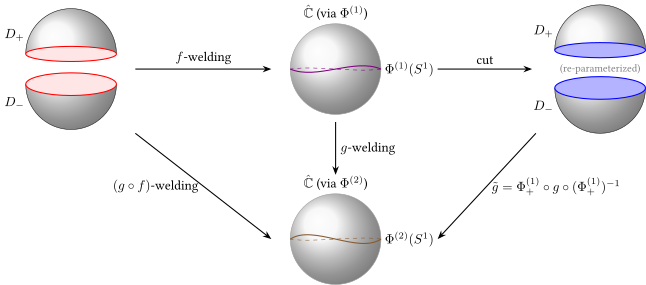
Proof The key point here is how to interpret the welding process. We consider the situation illustrated in the following diagram. Note that, rather than drawing the abstract Riemann surfaces, the spheres and disks shown are the images of the holomorphic embeddings of the welded Riemann surfaces into the Riemann sphere. Concretely, in the cut step we cut the -welded Riemann surface along the seam, so that the corresponding image (the Riemann sphere) is cut along . Performing a subsequent -welding then requires a change of coordinates, since the seam is not the standard circle .
So we have the following equations of the conformal welding problems: Now define and , then for all there holds Moreover, the normalization condition is met as well, say and , then So is the unique solution to the -welding problem.
Lemma
Real analytic orientation preserving diffeomorphisms are dense in with respect to the -topology.
Proof For any , we lift it to a smooth map such that Note that the derivative is a -periodic smooth function, so by Fourier theory, we can approximate it uniformly by a trigonometric polynomial which is everywhere positive. Define real analytic If is chosen close enough to in sup-norm, then both and its derivative are uniformly close to and . This means can be made arbitrarily small, thus the real analytics are dense in .
Lemma
The -welding problem (of two disks) has a unique solution for all that is close enough to the identity in -topology.
Proof Let be the Hardy space, and be the Hilbert transform. In other words, . Let be the operator of precomposition by . Then the -welding problem can be rephrased as follows: where is the inclusion map .
We first show that the operator is invertible and if , are a solution to the -welding problem then they have to be of the form Notice that so , thus . Let us see how acts on a function : where the integral over should be interpreted as the integral of the corresponding lifted functions on the interval , i.e., the last line above is Therefore the integral kernel of is It remains to verify that such and is a solution to the -welding problem. When is real analytic, extends holomorphically to annuli on both sides of , so the the welded surface is conformally equivalent to the Riemann sphere by the Riemann uniformization theorem. For arbitrary , since depends continuously on , and is dense, is solution to the -welding problem for arbitrary as well.
Theorem
The -welding problem (of two disks) has a unique solution for all , thus the welding operation is a well-defined semigroup operation on .
Proof From the above lemma, we know that every -welding problem has a unique solution for close to the identity. Note that is generated by any neighborhood of the identity, so the lemma implies that the welding operation is well-defined for all . It remains to check that the welding is independent of choice of representative. Suppose we have two equivalent annuli and with biholomorphic map . When welding with another annulus , we can define by This map is well-defined and biholomorphic, so the two welded annuli are equivalent.
 So we have the following equations of the conformal welding problems: