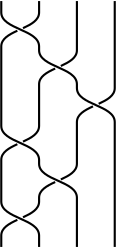
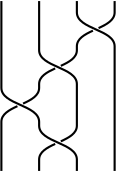
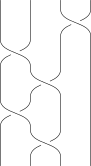
The Fundamental Braid

Positive Braid

A positive braid is the braid that can be written as product of positive powers of generators. Denote the set of positive -braids as , clearly forms a monoid.

Garside's Fundamental Braid

The Garside’s fundamental braid is the unique positive braid in such that any two strands cross exactly once. That is, it is the half twist of the identity braid. One representative of in is We shall normally abbreviate to the simpler form once the braid group is given.

e.g. The following braids are fundamental braids:
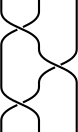
fundamental_braid_1.svg|80 fundamental_braid_2.svg|120

Proposition

The following statements are equivalent:

  1. is the fundamental braid in .
  2. is the unique positive braid where any two strands cross exactly once.
  3. is the half twist of the identity braid of strands.

Proof We omit the proof of the uniqueness of a positive braid where any two strands cross exactly once. A technical proof may involve lattice structures and Garside theory.
: It is straightforward to see that is a positive braid where any two strands cross exactly once by stacking generators.
: If is a positive braid where any two strands cross exactly once, we determine the permutation it induces. Since strand crosses each of strands exactly once, it must end at position . Similarly, strand crosses strands exactly once, meaning it crosses all strands except itself. Since it has already crossed strand (which is now at position ), strand must end at position . Continuing this reasoning, strand must end at position . This corresponds to the reverse permutation . A half-twist of the identity braid rotates the bottom endpoints by , sending strand to position . Therefore, induces the same permutation as a half-twist. Moreover, since each pair of strands crosses exactly once, the geometric realization of corresponds precisely to a half-twist.
: If is the half-twist of the identity braid, one can easily verify that is a valid word representation.

Proposition

The fundamental braid can always be expressed in a word that begins or ends with any generator while remaining positive. That is, for any generator , we can find positive braids and such that

Lemma

In , the identity holds.

Proof One can show this algebraically using the braid word expression of , by inductively proving that for all . Here, we present a more intuitive geometric proof using the half-twist definition. A key property of twisting is that its application is independent of location. Thus, for , we can apply the inverse half-twist—fixing the top endpoints and , while rotating the bottom endpoints by —which results in . Similarly, for , we fix on top and rotate the bottom by . This flips the crossing of the th and th strands to the left, ultimately yielding . Consequently, and are identical after applying the inverse half-twist, implying they were originally equal. A similar equation holds for , but in this case, we apply a half-twist instead.

fundamental_braid_prop_1

Corollary

commutes with every generator. In fact, the centre of is cyclic and generated by .

Proof It suffices to show that it commutes with all generators. For any positive integer , we have

Reflection

Reflection

Define the automorphism of conjugating elements with as the reflection . That is Clearly it maps any generator to .

Proposition

is the identity automorphism.

Proof The last equality follows from the fact that commutes with every generator.

Prefix

Prefix

Let . We define if there exists such that , said is a prefix of .

Proposition

The prefix relation is a partial order on , invariant under left multiplication.

Proof

Greatest Common Prefix

For any two elements there exists a unique greatest common prefix , that is , , and if and then .

Garside Normal Form

Permutation Braids

The positive prefixes of are called permutation braids.

e.g. Consider , , two of the permutation braids are and :
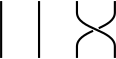
permutation_braids_1.svg|120 permutation_braids_2.svg|120

We can see that and .

By the crossing number definition of the fundamental braid, each prefix corresponds to a braid in which each pair of strands crosses at most once. In fact, we have the following proposition:

Proposition

The following statements are equivalent for a positive braid :

  • is a permutation braid.
  • Each pair of strands in crosses at most once.
  • .

If is a positive braid where no pair of strands crosses more than once, it induces a unique permutation in the symmetric group , where is the isomorphism . Conversely, every permutation can be realized by such a braid. Thus, any positive permutation braid is uniquely identified by a permutation in . These permutation braids serve as the fundamental building blocks of the normal form. Suppose is a positive braid. We can attempt to factor it into a product of permutation braids using a greedy approach: first, select the longest possible prefix of that forms a valid permutation braid by ensuring that each pair of strands crosses at most once. Then, continue this process with the remaining part of .

e.g. In , let . Clearly, is a permutation braid. Extending further, remains a valid permutation braid, as each pair of strands crosses at most once. However, adding to this prefix results in , where the first and second strands cross a second time, violating the condition (see below diagram). Thus, we factor out , leaving the remainder , which can be similarly verified as a permutation braid.

To ensure uniqueness in this factorization, at each step, we extract the longest possible permutation braid, meaning that any longer prefix would fail to be a permutation braid. To formalize this property, we define such a product as left-weighted:

Left-Weighted

A product of permutation braids is called left-weighted if .

Now we can express any positive braid as a product of permutation braids. To extend this unique factorization to all braids, we require an algorithm that transforms any braid containing negative generators into a positive braid.

Since the fundamental braid can always be rewritten to end with any generator while remaining positive, each inverse generator in a braid can be rewritten as . Here, is a positive braid, where the last generator of cancels with .

By the lemma all occurrences of can be pulled to the front by flipping the indices of the generators preceding it. Consequently, we can express in the form , where is a positive braid. Applying the earlier factorization technique to , we obtain the Garside normal form:

Garside Left Normal Form

Every braid can be represented uniquely as a braid word where , each is a permutation braid, and is left-weighted. And we call the canonical length of and the integer the infimum of .

Proof Whereas it is easy and intuitive to describe this form in , proving its uniqueness rigorously requires significantly more work. For detailed proofs, one can refer to Garside’s original paper.

e.g. In , the fundamental braid is given by . Consider the braid . We can factor it step by step into its Garside normal form as follows: Here, and are permutation braids. Thus, we conclude that and the canonical length of is .

References