Long Exact Sequence of a Good Pair
Let’s recall the definition of exact sequences in the context of abelian groups:
A sequence of morphisms between objects in an abelian category
Link to originalis exact at if . The sequence is an exact sequence if it is exact at every object. 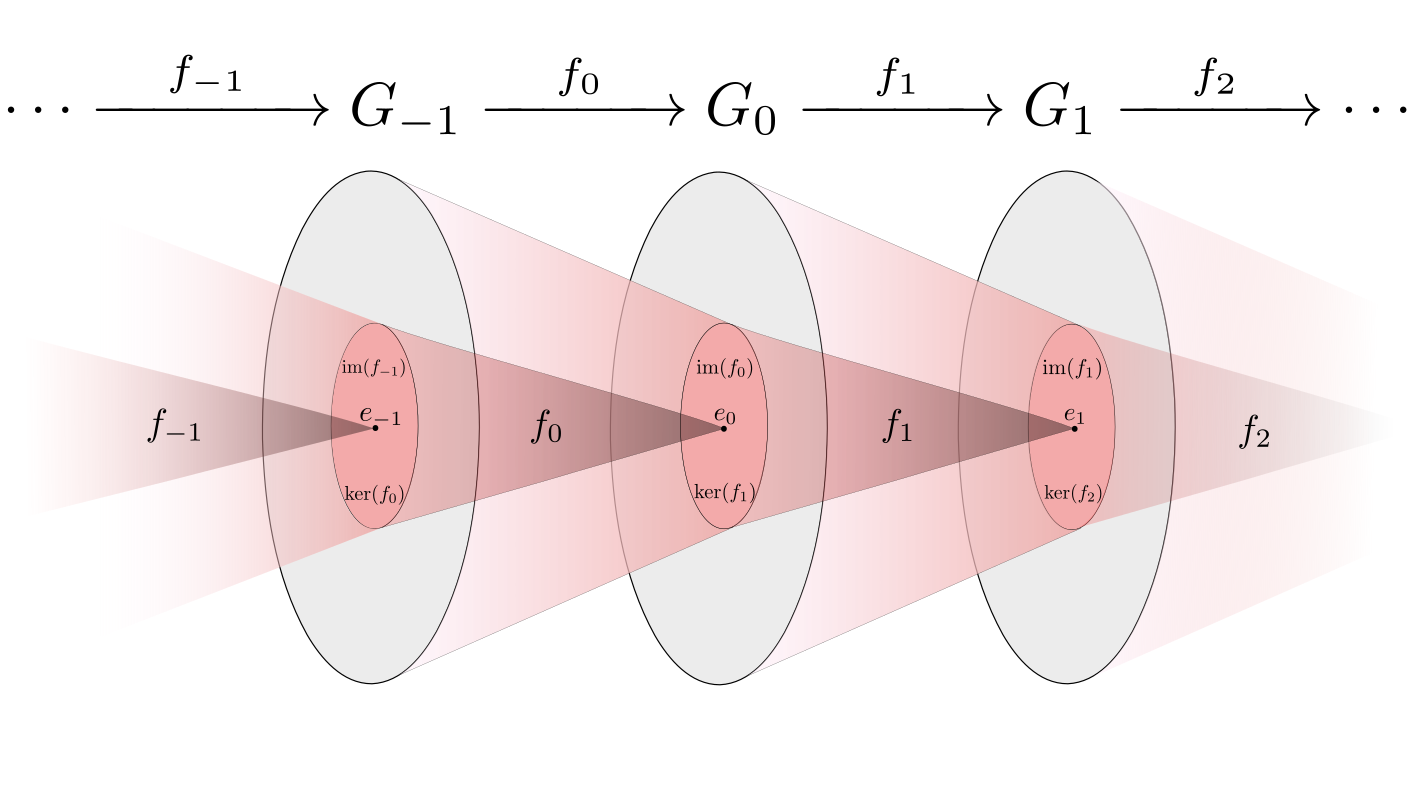
Good Pair
A pair
with is called a good pair if is a non-empty closed subset of that has an open neighborhood which deformation retracts onto .
Optionally, we can write the sequence in reduced homology as:
Link to originalBut note that is always reduced.
To prove this theorem we need the notion of relative homology and several lemmas:
Relative Chains and Homology
For any pair
, the relative chain groups are defined as the quotient . The boundary map on induces a boundary map , turning it into a chain complex. The homology of this complex, denoted , is called the relative homology of the pair .
From Short to Long Exact Sequences
Lemma
For any pair
, there is a long exact sequence relating their homology groups:
This sequence arises from a short exact sequence of chain complexes. Recall that the relative chain group is defined as the quotient
From Short to Long Exact Sequences
A short exact sequence of chain complexes
induces a long exact sequence in homology:
Long Exact Sequence for a Triple
For a triple of spaces
, there is a corresponding long exact sequence of relative homology groups: This arises from the short exact sequence of relative chain complexes: This follows from the isomorphism .
Proof We need to construct the connecting map 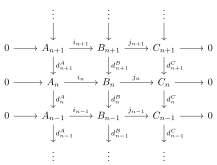 The construction of
- Take a homology class
and choose a representative cycle for this class. - Since
is surjective, there exists some such that . - Consider the boundary
. By the commutativity of the diagram ( ), we have: - This implies
. By exactness at , . Therefore, there exists a unique such that . Uniqueness follows from being injective. - This element
is a cycle. To see this, note that is injective, and: Since is injective, .
Finally, we define
- Independence of the representative
: Suppose we choose another representative for the same homology class . Since is surjective, we can find such that . Let . Then . Now, we compute the boundary of : The new element we find is the same, so the result is unchanged. - Independence of the lift
: Suppose we choose a different element such that . Then , so . Thus, there exists some such that , so . Now consider the boundary of : The new element is defined by . Thus: Since is injective, . This means and are in the same homology class.
Thus, the connecting homomorphism is well-defined.
To prove the sequence is exact, one must verify that
- Exactness at
: We show . : For any , . Since the sequence of chain complexes is exact, , so the induced map is also zero. Thus .
- Exactness at
: We show . - Let
, represented by a cycle with . Then . To compute , we follow the construction: - Representative cycle is
. - Lift
to . We can choose itself. - Compute its boundary:
. - This means the corresponding element
is . - Therefore,
. So .
- Representative cycle is
- Let
- Exactness at
: We show . - Let
such that . We want to find a class such that . - Let
be a cycle representing . means that is a boundary in . So there is some with . - Let
. - We check if
is a cycle: . Since , we have . - So,
. By construction, is the class represented by the element such that . But , so . - Thus
, which shows .
- Let
- Let
Applications and Examples
e.g. Consider the pair
e.g. Consider the pair
Excision Theorem
For any
such that , the inclusion induces an isomorphism .
Lemma
For a good pair
, the relative homology is isomorphic to the reduced homology of the quotient space: