Cellular homology provides a powerful and efficient method for computing the homology groups of CW complexes. It relies on a chain complex constructed directly from the cells of the CW structure.

The Cellular Chain Complex

Lemma

Let be a CW complex with as its -skeleton.

  1. The relative homology group is given by: where denotes the free abelian group generated by the -cells.
  2. For , the homology group .
  3. The inclusion map induces a map on homology which is an isomorphism for and surjective for .

Proof Sketch

  1. The pair is a good pair, and the quotient space is a wedge sum of -spheres, one for each n-cell of . Thus, , which gives the result.
  2. This is shown by considering the long exact sequence for the pair and using induction on .
  3. This follows from considering the long exact sequence of the pair . Any cycle in is compact and can be deformed into some finite skeleton , which allows us to relate to the homology of its skeletons.

We can now define a chain complex based on the structure of a CW complex .

Cellular Chain Groups

The cellular chain group is the free abelian group generated by the -cells of . By the lemma above, we have an isomorphism: The cellular boundary map is defined as the composite of maps from the long exact sequence of the pair : where is the mystery map and is induced by inclusion.

Lemma

The composition of two consecutive cellular boundary maps is zero, i.e., . Thus, forms a chain complex.

Proof The composition involves the segment . This is a portion of the long exact sequence for the pair , so the composition . The full map is . Since , the entire composition is zero.

Cellular Homology

The -th cellular homology group of is the homology of this chain complex:

The key result is that this new homology theory is naturally isomorphic to the singular homology.

Theorem

For a CW complex , the cellular homology is isomorphic to the singular homology:

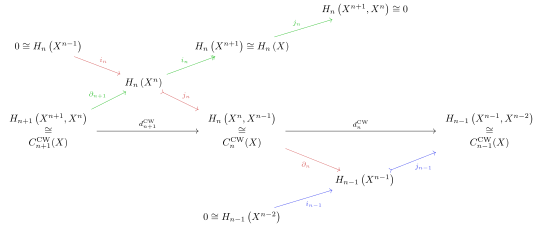
Proof The situation is summarized by the following commutative diagram: https://q.uiver.app/#q=WzAsOSxbMSwyLCJIX3tufVxcbGVmdChYXm5cXHJpZ2h0KSJdLFswLDMsIkhfe24rMX1cXGxlZnQoWF57bisxfSxYXm5cXHJpZ2h0KSBcXFxcIFxcY29uZyBcXFxcIENfe24rMX1ee1xcbWF0aHJte0NXfX0oWCkiXSxbMiwzLCJIX3tufVxcbGVmdChYXntufSxYXntuLTF9XFxyaWdodCkgXFxcXCBcXGNvbmcgXFxcXCBDX3tufV57XFxtYXRocm17Q1d9fShYKSJdLFs0LDMsIkhfe24tMX1cXGxlZnQoWF57bi0xfSxYXntuLTJ9XFxyaWdodClcXFxcIFxcY29uZyBcXFxcIENfe24tMX1ee1xcbWF0aHJte0NXfX0oWCkiXSxbMyw0LCJIX3tuLTF9XFxsZWZ0KFhee24tMX1cXHJpZ2h0KSJdLFsyLDUsIjBcXGNvbmcgSF97bi0xfVxcbGVmdCggWF57bi0yfSBcXHJpZ2h0KSJdLFswLDEsIjBcXGNvbmcgSF97bn1cXGxlZnQoIFhee24tMX0gXFxyaWdodCkiXSxbMiwxLCJIX25cXGxlZnQoIFhee24rMX0gXFxyaWdodClcXGNvbmcgSF9uXFxsZWZ0KCBYIFxccmlnaHQpIl0sWzMsMCwiSF9uXFxsZWZ0KCBYXntuKzF9LFhebiBcXHJpZ2h0KVxcY29uZyAwIl0sWzEsMiwiZF97bisxfV57XFxtYXRocm17Q1d9fSJdLFsxLDAsIlxccGFydGlhbF97bisxfSIsMCx7ImNvbG91ciI6WzEyMCw2MCw0N119LFsxMjAsNjAsNDcsMV1dLFswLDIsImpfbiIsMCx7ImNvbG91ciI6WzAsNjAsNjBdfSxbMCw2MCw2MCwxXV0sWzIsMywiZF97bn1ee1xcbWF0aHJte0NXfX0iXSxbMiw0LCJcXHBhcnRpYWxfbiIsMix7ImNvbG91ciI6WzAsNjAsNjBdfSxbMCw2MCw2MCwxXV0sWzQsMywial97bi0xfSIsMix7ImNvbG91ciI6WzIzNyw4NSw2MF0sInN0eWxlIjp7InRhaWwiOnsibmFtZSI6Im1vbm8ifX19LFsyMzcsODUsNjAsMV1dLFs1LDQsImlfe24tMX0iLDIseyJjb2xvdXIiOlsyMzcsODUsNjBdfSxbMjM3LDg1LDYwLDFdXSxbNiwwLCJpX24iLDAseyJjb2xvdXIiOlswLDYwLDYwXSwic3R5bGUiOnsidGFpbCI6eyJuYW1lIjoibW9ubyJ9fX0sWzAsNjAsNjAsMV1dLFswLDcsImlfe259IiwwLHsiY29sb3VyIjpbMTIwLDYwLDQ3XSwic3R5bGUiOnsiaGVhZCI6eyJuYW1lIjoiZXBpIn19fSxbMTIwLDYwLDQ3LDFdXSxbNyw4LCJqX3tufSIsMCx7ImNvbG91ciI6WzEyMCw2MCw0N119LFsxMjAsNjAsNDcsMV1dXQ== where the arrows with same colors come from the same section of the long exact sequence. Define as follows: Take , since is surjective, there exists such that . Define . We need to check that is well-defined. Firstly, because . Thus, . Secondly, we need to show that does not depend on the choice of . If there is another such that , then , so for some . Thus, , which implies . And clearly that is a homomorphism, so it is well-defined. Next, we show that is injective. If , then for some . Since is injective, , which implies . Thus, and is injective. Finally, we show that is surjective. For any with , so that . Since is injective, , which implies . Thus, there exists such that . Define , then . So is surjective.
Cellular Boundary Formula

To compute the boundary maps in practice, we use a formula based on the degrees of maps.

Cellular Boundary Formula

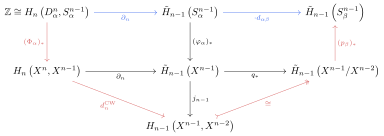
If we denote the -cells by and the -cells by , the boundary map is given by: The coefficient is the degree of the composite map: where is the attaching map of the cell , is the quotient map, and is the projection onto the sphere corresponding to the cell .

Proof Observe that the following diagram commute: https://q.uiver.app/#q=WzAsNyxbMiwwLCJcXHRpbGRle0h9X3tuLTF9XFxsZWZ0KCBTXntuLTF9X3tcXGFscGhhfSBcXHJpZ2h0KSJdLFsyLDIsIlxcdGlsZGV7SH1fe24tMX1cXGxlZnQoIFhee24tMX0gXFxyaWdodCkiXSxbMiw0LCJIX3tuLTF9XFxsZWZ0KCBYXntuLTF9LCBYXntuLTJ9IFxccmlnaHQpIl0sWzQsMCwiXFx0aWxkZXtIfV97bi0xfVxcbGVmdChTXntuLTF9X3tcXGJldGF9XFxyaWdodCkiXSxbNCwyLCJcXHRpbGRle0h9X3tuLTF9XFxsZWZ0KCBYXntuLTF9L1hee24tMn0gXFxyaWdodCkiXSxbMCwyLCJIX3tufVxcbGVmdCggWF57bn0sIFhee24tMX0gXFxyaWdodCkiXSxbMCwwLCJcXG1hdGhiYntafVxcY29uZyBIX3tufVxcbGVmdCggRF97XFxhbHBoYX1ee259LCBTX3tcXGFscGhhfV57bi0xfSAgXFxyaWdodCkiXSxbMCwxLCIoXFx2YXJwaGlfXFxhbHBoYSlfKiJdLFsxLDIsImpfe24tMX0iXSxbMCwzLCJcXGNkb3QgZF97XFxhbHBoYVxcYmV0YX0iLDIseyJjb2xvdXIiOlsyMjUsODMsNjBdfSxbMjI1LDgzLDYwLDFdXSxbMSw0LCJxXyoiLDJdLFs1LDEsIlxccGFydGlhbF9uIiwyXSxbMiw0LCJcXGNvbmciLDIseyJjb2xvdXIiOlswLDYwLDYwXSwic3R5bGUiOnsidGFpbCI6eyJuYW1lIjoibW9ubyJ9LCJoZWFkIjp7Im5hbWUiOiJlcGkifX19LFswLDYwLDYwLDFdXSxbNSwyLCJkX25ee1xcbWF0aHJte0NXfX0iLDIseyJjb2xvdXIiOlswLDYwLDYwXX0sWzAsNjAsNjAsMV1dLFs2LDAsIlxccGFydGlhbF9uIiwyLHsiY29sb3VyIjpbMjI1LDgzLDYwXX0sWzIyNSw4Myw2MCwxXV0sWzYsNSwiKFxcUGhpX1xcYWxwaGEpXyoiLDIseyJjb2xvdXIiOlswLDYwLDYwXX0sWzAsNjAsNjAsMV1dLFs0LDMsIihwX1xcYmV0YSlfKiIsMix7ImNvbG91ciI6WzAsNjAsNjBdfSxbMCw2MCw2MCwxXV1d Following the blue route, will be sent to , while following the red route, will be sent to , which is the coefficient of in . Since the diagram commutes, these two must be equal.
Comparison with Simplicial Homology

For simplicial homology, the chain group is the free abelian group on the -simplices of . The coefficients of the boundary map are always or .

Example: Real Projective Space

The real projective space has a CW structure with exactly one -cell in each dimension for . The cell is attached to the -skeleton via the standard 2-sheeted covering map . The cellular chain complex is for and otherwise. The boundary map is determined by the degree of the composite map: Let’s call this composite map . To find its degree, we can sum the local degrees over the preimage of a regular point . The preimage under consists of two points, which we can identify with and its antipode in the domain .

  1. Near , the map is a local homeomorphism that preserves orientation. The local degree is +1.
  2. Near , the map is a composition of the antipodal map (which has degree ) and an orientation-preserving local homeomorphism. The local degree is .

Therefore, the total degree is . The boundary map is multiplication by this integer:

In general, the homology of is:

Example: Surface of Genus g

A standard CW structure for the orientable surface of genus , , has:

  • 1 0-cell (a point).
  • 1-cells, denoted .
  • 1 2-cell, , attached along the path .

The cellular chain complex is .

  • The map is the zero map because the boundary of each 1-cell is the single 0-cell, mapping to .
  • To compute , we find the degree of the attaching map projection. For each , the attaching map traverses once forward and once backward (). The corresponding degrees cancel out, so . The same logic applies to the ‘s, so .
  • Therefore, both and are zero maps.

The homology groups are then the chain groups themselves:

Example: Complex Projective Space

The complex projective space has a CW structure with one cell in each even dimension for . The chain complex consists of in even dimensions and 0 in odd dimensions:All boundary maps must be zero since they map from or to a zero group. The homology groups are therefore the chain groups themselves: