Field Extensions and Common Fields
Field Extension
The field
is an extension of the field if . We write to denote this extension.
Here are the three most important classes of fields:
Number Fields, Finite Fields and Function Fields
A number field is a subfield of
. A finite field is a field with finitely many elements. A function field is an extension field of of rational functions in one variable.
Algebraic and Transcendental Elements
Algebraic & Transcendental
Suppose
is an extension of a field . An element is algebraic over if there exists a nonzero monic polynomial such that . Otherwise, it is called transcendental.
e.g.
Proposition
Suppose
is an extension of a field . Fix some , consider Then is algebraic over if and only if . Equivalently, is transcendental over if and only if is injective.
Proof This is a direct consequence of the definition.
Proposition
Fix some algebraic
over . Then the following are equivalent for a monic polynomial :
is the monic polynomial of lowest degree such that . is irreducible in and . , and is a maximal ideal in . , and whenever for some , then .
Proof The equivalence of the first two statements, and the last two statements are straightforward. We will prove
Minimal Polynomial & Degree of an Algebraic Element
The unique monic polynomial in the above proposition is called the minimal polynomial of
over , and its degree is called the degree of over , denoted by .
Generated Field Extension
Let
be an extension field of . The subfield of generated by and an element is denoted by . That is, is the smallest subfield of containing and . Similarly, is the smallest subfield containing and .
Remark
Note that we denote
as the smallest ring containing and . It is not necessarily a field. Indeed, .
Proposition
Let
be an element of an extension field which is algebraic over , and let be the irreducible polynomial for over . Then
- The canonical map
is an isomorphism, and is a field. Thus . - More generally, let
be elements of an extension field , which are algebraic over . The ring is equal to the field .
Proof Let
Proposition
Let
be an algebraic element over , and let be the irreducible polynomial for over . If has degree , i.e., if has degree over , then is a basis for as a vector space over .
Proof Firstly, it is obvious to see that
e.g. Suppose
Remark
It may not be easy to tell whether two algebraic elements
and generate isomorphic field extensions, but the above proposition provides a necessary condition: they must have the same degree over .
Isomorphism of Field Extensions
Let
and be extensions of the same field . An isomorphism that restricts to the identity on the subfield is called an -isomorphism, or an isomorphism of field extensions. If there exists an -isomorphism , and are isomorphic extension fields.
Proposition
Let
be a field, and let and be elements of field extensions and . Suppose that and are algebraic over . There is an -isomorphism of fields that sends if and only if the irreducible polynomials for and over are equal.
Proof Let the shared irreducible polynomial be
Proposition
Let
be an -isomorphism, and let . Let be a root of in , and let be its image in . Then is also a root of .
Proof Suppose
Degrees of Field Extensions
Now we generalize the idea of the proposition to any field extension. Note that a field extension
Degree of a Field Extension
Suppose
is a field extension. Then the dimension of , when regarded as an -vector space, is called the degree of the field extension. This degree is denoted by or . A field extension is a finite extension if its degree is finite. Extensions of degree are quadratic extensions, those of degree are cubic extensions, and so on.
Lemma
The followings are true:
- A field extension
has degree if and only if . - An element
of a field extension has degree over if and only if is an element of .
Proof If
Proposition
are fields. Suppose is algebraic over . Then if and only if the minimal polynomial of is of degree .
Proof Let
Characteristic
Let
be the unique ring homomorphism from the integers to a ring . Then the characteristic of is the smallest nonnegative integer such that . i.e. is the smallest positive integer such that in , or if no such integer exists.
Proposition
Assume that the field
does not have characteristic , that is, in . Then any extension of degree over can be obtained by adjoining a square root: , where is an element of . Conversely, if is an element of a field extension of , and if is in but is not in , then is a quadratic extension of .
Remark
However, it is not true that all cubic extensions can be obtained by adjoining a cube root.
Theorem
If
is a field extension of , and , then every element of is algebraic over .
Proof Assume there is a transcendental element
Multiplicative Property of the Degree
Suppose
, where , are fields and is a ring. Then
Proof Suppose
One takeaway from the above theorem is that
Corollary
Let
be an extension field of of prime degree . If an element of is not in , then has degree over and .
Corollary
Let
be a sequence of field extensions. If an element is algebraic over , then is algebraic over and is at most .
Proof Let
Corollary
Let
and be finite extensions of , and let denote the field generated by the two fields and together. Let , and . Then and divide , and .
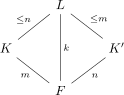
Proof The multiplicative property shows that
So one can apply the above proposition to help to find the minimal polynomial of an algebraic element over a field.
e.g.
Ruler and Compass Constructions
Ruler and Compass Constructions
A ruler and compass construction is a method of drawing geometric figures using only a straightedge (ruler) and a compass.
- Two points in the plane are given to start the construction.
- The straightedge can be used to draw a line between any two points.
- The compass can be used to draw a circle with a given center and a point on the circle.
We say the points of intersection of the lines and circles are constructed points. Points, lines, and circles will be called constructible if they can be obtained in finitely many steps, using these rules.
Theorem
Let
be a constructible point in the plane. Then there is a chain of field extensions such that the coordinates of are in , and each extension is a quadratic extension.
Corollary
Let
be a constructible real number. Then is algebraic over and the degree of over is a power of .