Introduction
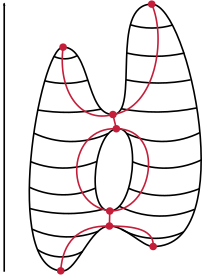
Morse theory is a central tool in differential topology that studies the global shape (topology) of a smooth manifold by analyzing a “generic” smooth real-valued function on it, called a Morse function, whose critical points are all nondegenerate (its Hessian is invertible at those points). The key idea is that as you sweep through the manifold by increasing the function value, the topology of the sublevel sets changes only when you pass a critical value, and the type of change is controlled by the index of the corresponding critical point (roughly: minimum, saddle, maximum, etc.). This viewpoint leads to concrete decompositions of manifolds into cells/handles and yields powerful consequences such as Morse inequalities, relating counts of critical points to homological invariants like Betti numbers.
Contents
Manifolds, Atlases and Smooth Structures
Morse Functions and Critical Points
Morse Inequalities and Homology
Handle Decompositions and Cobordisms
Morse Homology and Floer Theory