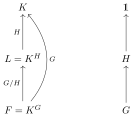
Field Extension Automorphisms
Galois Group
Suppose
is a finite field extension. Then the Galois group is the group of all $F$-automorphisms of (an -automorphism is a field extension isomorphism ).
Let, then we write as the Galois group of the splitting field of over .
Galois Extension
e.g. The complex conjugate is a
Proposition
Fix some
. permutes the roots of . In particular, where is the degree of and is the symmetric group on elements.
Lemma
Let
be a finite field extension. If a polynomial is irreducible, then acts transitively on its roots.
Fixed Fields
Fixed Field Theorem
Let
be a finite group of automorphisms of a field , and let be its fixed field. Then is a finite extension of , and its degree , which is the order of .
e.g.
Lüroth's theorem
Let
be a subfield of the field of rational functions that contains and is not itself. Then is isomorphic to a field of rational functions.
Galois Extensions
Intermediate Field
If
is a field extension of , an intermediate field is a field such that . An intermediate field is proper if and .
Characterization of Galois Extensions
Let
be a finite extension and let be its Galois group. The followings are equivalent:
is a Galois extension; - The fixed field
is equal to ; is the splitting field over .
Corollary
One can deduce the following properties from the above theorem:
- Every finite extension
is contained in a Galois extension. - If
is a Galois extension with Galois group , and if is an intermediate field, then is also a Galois extension of , and the Galois group of over is a subgroup of .
Proof The first statement holds because every finite field extension is contained in a splitting field, which is a Galois extension. For the second statement, if
Normal Extension and Separability
Normal Extension
is a normal extension if every element of has its minimal polynomial over split completely in . Equivalently, is a normal extension if and only if every irreducible either has no roots in or splits completely in .
In other words, a normal extension never contains “only some” of the roots. If it contains one root, it contains the entire root set. The two definitions are equal because if
e.g.
- Every quadratic extension
is normal, because the minimal polynomial of any element in is quadratic, and a quadratic polynomial either has no roots or splits completely.
Though normal extensions can be infinite, we are more interested in the finite extensions, which turn out to be just splitting fields:
Proposition
A finite extension
is normal if and only if is the splitting field of some polynomial .
Proof It is clear by definition that if
It is sufficient
Separable Extension
is separable if the minimal polynomial of any element has no multiple roots.
e.g. We will see that most extensions in real life is separable, but here is one that is not: Consider the field
Lemma
A polynomial
for some field has no repeated roots if and only if and its formal derivative are coprime in .
e.g. Consider the example above,
Proposition
Every algebraic extension of a field of characteristic zero is separable, and every algebraic extension of a finite field is separable.
The Main Theorem
Main Theorem of Galois Theory
Let
be a Galois extension. Let be its Galois group. There is a one-to-one correspondence between the subgroups of and the intermediate fields such that . The correspondence is given by where is the fixed field of , or conversely , sending an intermediate field to its Galois group.
Theorem
Let
be a Galois extension with Galois group , and let be the fixed field of a subgroup . The extension is a Galois extension if and only if is a normal subgroup of . In this case, the Galois group is isomorphic to the quotient group .