Yang-Baxter Object

Suppose is a monoidal category. A Yang-Baxter object is an object equipped with an automorphism called a Yang-Baxter operator such that
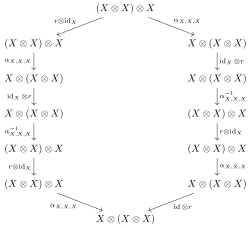
commutes.

Yang-Baxter Operator ^9fa28c

Let be a monoidal category. A Yang-Baxter object is an object equipped with an automorphism , called a Yang—Baxter operator, such that the Yang—Baxter equation holds for , , , and .
In the case of a strict monoidal category, this is equivalent to the equation

holding.

Proposition

Suppose is a Yang—Baxter operator. Fix some integer . For all , define
Then .

Proof Without loss of generality, we assume strict monoidal category is strict. For the non-strict case, we only need to insert some associators carefully in the computation. Observe that in only affects the three tensor factors, this means

Misplaced & & c_j^{(n)} c_{j+1}^{(n)} c_j^{(n)} \\ =&\, \left(\id_X^{\otimes (j-1)} \otimes r \otimes \id_{X}^{\otimes (n-j-1)}\right) \left(\id_X^{\otimes (j)} \otimes r \otimes \id_{X}^{\otimes (n-j-2)}\right) \left(\id_X^{\otimes (j-1)} \otimes r \otimes \id_{X}^{\otimes (n-j-1)}\right) \\ =&\, \id_X^{\otimes (j-1)} \otimes [(r\otimes \id_X) (\id_X\otimes r) (r \otimes \id_X)] \otimes \id_X^{\otimes(n-j-2)}. \end{aligned}$$ Similarly, $$c_{j+1}^{(n)} c_j^{(n)} c_{j+1}^{(n)} = \id_X^{\otimes (j-1)} \otimes [(\id_X \otimes r) (r \otimes \id_X) (\id_X\otimes r)] \otimes \id_X^{\otimes(n-j-2)}.$$ So the equation in the [[Yang-Baxter Equation#^9fa28c|definition]] implies the desired equality.