Braid Category
The braid category
is a braided monoidal category whose objects are natural numbers (equivalently, collections of dots), and whose morphisms are automorphisms represented by elements of the braid groups . The monoidal product is given by addition on objects and juxtaposition on morphisms. The braiding is represented by the braid
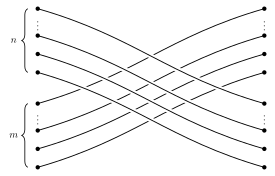
Remark
One can see that
indeed satisfies the braiding axioms by the braid relation. A graphical proof is provided in \cite[Theorem XIII.2.1]{kasselQuantumGroups1995}.
e.g. For example, the following is a morphism
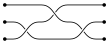
This means in

Theorem
The braid category
is the free (strict) braided monoidal category generated by one object.
Proof For any strict braided monoidal category
Moreover, the elementary braid generator
It remains to verify that this assignment respects the braid relations: