Subobjects
Subobject
A subobject of an object
in a category is a monomorphism Given subobjects of , a morphism is an morphism in . Thus we have a category of subobjects of in .
Inclusion of Subobjects
We define the relation of inclusion of subobjects by:
Equivalence of Subobjects
We say that subobjects
and are equivalent if and , write .
Proposition
Equivalent subobjects have isomorphic domains.
Proof Observe that, if
Remark
We sometimes abuse notation and language by calling
the subobject when the monomorphism is clear.
Local Membership
In terms of generalized elements
of an object , we define the local membership relation as
Pullback
Pullback
In any category
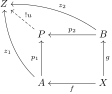
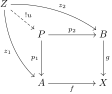
, a pullback of morphisms with consists of an object together with morphisms , such that , and universal with this property. i.e., given any and with , there exists a unique with and :
We write suchas .
e.g. In
Corollary
If a category
has binary products and equalizers, then it has pullbacks.
e.g. An explicit construction of a pullback in
Proposition
Given a pullback
in any category:
Ifis monic, then is monic as well.
Proof The following diagram commutes:
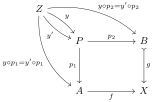
Then by uniqueness of the pullback, we have
Two-Pullbacks
Consider the commutative diagram below in a category with pullbacks:
- If the two squares are pullbacks, so is the outer rectangle. That is
- If the right square and outer square are pullbacks, so is the left square.

Corollary The pullback of a commutative triangle is a commutative triangle. Specifically, given a commutative triangle as on the right end of the following “prism diagram”:
Prop For fixed
Proof
Prop A category has finite products and equalizers iff it has pullbacks and a terminal object.
Proof The “only if” direction has already been done. For the other direction, suppose
Pushout
Pushout
In any category
, a pushout of morphisms with consists of an object together with morphisms , such that , and universal with this property. i.e., given any and with , there exists a unique with and :
We write suchas .