Clearly, finite sets and functions between them form a category , which is a full subcategory of . is a symmetric monoidal category with disjoint union as the monoidal product and the empty set as the monoidal unit. Moreover, is a symmetric monoidal category with the braiding given by the natural isomorphism between and .
Any two sets of the same cardinality are isomorphic in , so we can define the category of finite cardinals as the skeleton of . The objects of are the finite cardinals , and morphisms are functions between them.
On the other hand, the category of finite posets is also a subcategory of , and its skeleton is the category of finite ordinals , whose objects are the finite ordinals and morphisms are order-preserving functions between them. is also called the simplex category .
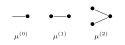
We can describe and using graphs, where each object is represented by dots (i.e., vertices), and morphisms are represented by strands (i.e., directed edges) between dots. In , we only require that for any dot in the domain, there is only one strand coming out; while in , the strands must also not cross each other. For example, a morphism in can be represented as follows:
Proposition
is generated by
under the relations
Proposition
Any morphism in is a composition of a bijection (i.e., permutation) and an order-preserving function : .
Remark
Note that the order matters here. In general, we cannot write .
Corollary
is generated by the following morphisms:
Theorem
is the free monoidal category on a single monoid object . That is, for any monoidal category and any monoid object in , there is a unique monoidal functor such that .
In other words, there is a canonical equivalence of categories
where is the category of monoidal functors from to , and is the category of monoid objects in .