A Smooth Approach
Knot and Link
A (smooth) knot is a smooth embedding
. More generally, a link with connected components is a smooth embedding of into .
When are two knots same?
Homotopy is a continuous deformation, which is not enough, because one path might cross itself under the deformation. We need to consider isotopy, which is a continuous deformation of embeddings. However, it turns out that isotopy is not enough either, because any tangle can be shrunk to a point.
To solve this, we need to consider one of the following:
- Ambient isotopy: a continuous deformation of the space.
- Smooth isotopy: a differentiable deformation of knots.
- Thick tubes instead of circles.
Knot Equivalence
We will say that two knots (or links)
and are equivalent if they are ambient isotopic, that is, if there is a continuous such that satisfy and . Such a map is called an ambient isotopy.
Remark
According to the definition, a knot or a link is a map. However, we are allowed to think about a knot or a link as the image of such maps, because knots with the same image are equivalent to each other.
e.g. The simplest knot is the unknot.
Knot Diagrams
Knot Diagram
A knot diagram (or link diagram) is a 4-valent graph with over/under crossing information at each vertex. The diagram is embedded in a plane
called the projection plane.
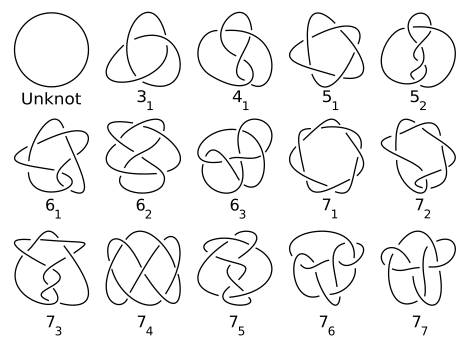
Reidemeister Moves
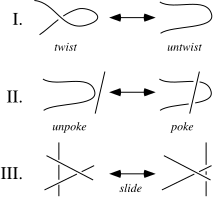
Two knot diagrams represent the same knot if and only if one can be obtained from the other by a finite sequence of Reidemeister moves. The below are three types of Reidemeister moves:
Remark
However, if a knot diagram
represents unknot, one may need a huge number of Reidemeister moves to show this. In fact, it is an open problem to determine the minimum number of Reidemeister moves required to show that a given knot diagram represents the unknot.
Algebraic Structure for Knots
Connected Sum
Connected sum is a binary operation on knots, denoted by
, where and are two knots. The connected sum of two knots is obtained by removing a small open disk from each knot and gluing the two resulting boundaries together.
e.g. 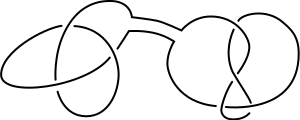
Why connected sum is well-defined?
First, it does not matter where we attach, because, say we are connecting
with , we can always move around to grow it back. Moreover, knots are naturally equipped with a counterclockwise orientation. The connected sum of two knots is well defined up to orientation. i.e. there is only one way to connect in an orientation-preserving way, and we can only pick one of the following:

Proposition
Connected sum is associative, unital and commutative. Thus the set of all knots with the connected sum operation forms a commutative monoid, denoted by
.
Proof Clearly the unit is the unknot, commutativity and associativity are inherited from the underlying operation.
Since such monoid is just isomorphic to positive integers with multiplication
Prime Knot
A knot is prime if it is not the connected sum of two non-trivial knots.
Theorem
Every knot has a unique prime decomposition. There are infinitely many prime knots.
Proof By the isomorphism and the fact that there are infinitely many prime numbers.