We want a better diagrammatic representation of singular knots, which is more flexible than the usual knot diagrams. We will use chord diagrams.
Chord Diagram
A chord diagram of degree
is an oriented circle with a distinguished set of disjoint pairs of distinct points, considered up to orientation preserving diffeomorphisms of the circle. The set of all chord diagrams of order will be denoted by . We shall usually omit the orientation of the circle in pictures of chord diagrams, assuming that it is oriented counterclockwise.
Remark
Only cyclic ordering of the endpoints and the partition into pairs matter, not the actual position of the points on the circle in a chord diagram.
e.g.

We can identify each chord diagram as an oriented knot by the following map:
Rubber Band Map
The rubber band map
is the map that sends a chord diagram to the singular knot diagram obtained by replacing each chord with a simple double point.
e.g. Let’s consider the simplest example of two chords:
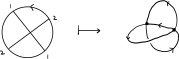
One might be confused, as how do we determine the over/under crossings of the remaining? It turns out that the remaining over/under crossings do not matter:

Proposition
The rubber band map is well defined.
Proof Under the rubber band map, each chord corresponds to a double point. The only choices can only be made at the “incidental crossings”. But the difference at each incidental crossing forms a double point, so the difference is in
1T and 4T Relations
We want a formal isomorphism between the algebra of chord diagrams and algebra of singular knots. One can see that chord diagrams are “freer”. To address this, we need extra relations on chord diagrams.
1-Term Relation
The 1-term relation is a relation on
that the chord diagram with an isolated chord is zero. where an isolated chord is a chord that does not intersect any other chord of the diagram.
4-Term Relation
The 4-term relation is a relation on
that

Proposition
is a well-defined algebra with connected sum of chord diagrams as a product.
Proof The connected sum of chord diagrams is defined as

It is compatible with the 1T relation, because connected sum doesn’t change the isolated chords. And 4T relation guarantees that the connected sum does not depend on where the glueing is made. It suffices to show that a blob of chords commutes with other chord endings.
Lemma
Let
be an algebra with connected sum of chord diagrams as a product. Then the rubber band map induces an surjective map .
Proof
Remark
The chord diagram connected sum is NOT well defined without the 1T and 4T relations. And indeed,
is injective as well, we will show this by a new gadget, formality.