The Cup Product
Cup Product
Let
be a ring. The cup product is a map given by the following formula. For , , and a singular -simplex , we define: Here, is the restriction of to the “front face” (a -simplex), is the restriction to the “back face” (an -simplex), and the product is taken in the ring .
The cup product interacts with the coboundary operator via the following rule.
Coboundary Formula for Cup Product
For
and , the following Leibniz-type rule holds:
An important consequence of this formula is that the cup product of two cocycles (
The Cohomology Ring
The above properties mean that
Theorem
is a unital, associative, ring under the cup product. The unit is represented by the cocycle which maps every 0-simplex (a point in ) to the multiplicative identity . This is called the cohomology ring of with coefficients in .
Proof of Unital Property Let
Induced Homomorphisms
Let
be a continuous map. The induced map on cohomology is a homomorphism of graded rings. That is, it preserves the ring structure:
e.g. The cohomology ring of the torus 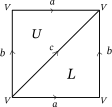 The chain complex is
If
Graded Commutativity
The cohomology ring is not strictly commutative in general, but it satisfies a property called super-commutativity or graded commutativity.
Graded Commutativity of the Cup Product
If
is a commutative ring, then for any cohomology classes and , the following relation holds:
Remark
An interesting consequence of graded commutativity is that for any element
of odd degree in a graded commutative ring , we have This implies . If the ring has no 2-torsion (e.g., if the coefficient ring is or ), this means .
e.g. The cohomology rings of real and complex projective spaces are fundamental examples.
- The infinite complex projective space
has a cohomology ring that is a polynomial ring on a single generator : - For the finite-dimensional complex projective space
, the ring is a truncated polynomial ring: with in degree , i.e., is the generator of . - The infinite real projective space
with coefficients also has a polynomial ring structure on a generator : - For the finite-dimensional real projective space
, the ring is aoh truncated polynomial ring: with in degree .
Moreover, the de Rham cohomology of a smooth manifold with real coefficients is a canonical example of a cohomology ring (see here).
Examples of Cohomology Rings
Exterior Algebra
The exterior algebra on generators
over a ring , denoted , is an algebra where the generators anti-commute ( ) and each generator squares to zero ( ). For example:
is additively with . is additively with , , and .