Fact Imposing Relations
We interpret the quotient
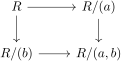
Adjoining Elements
A primary tool for constructing new rings is to take a ring
and a ‘free’ variable and create the polynomial ring, and then quotient by a polynomial. We show see this further in field extensions by adjoining roots of polynomials.
e.g. The complex numbers are constructed from
Proposition
If
in has no root in we can form the quotient and is a root of .
Definition
Whenever we have a subring
of a ring and an element we denote by the smallest subring of that contains and .
Proposition
defines an isomorphism .
Field of Fractions & Product Rings
The Field of Fractions
Suppose
is an integral domain. Consider equip with the following relation: This is an equivalence relation. Let denote the quotient. We denote the equivalence classes by .
Proposition
is a field.
Theorem
Suppose
is an integral domain and is defined as above. Define addition and multiplication on by Then is a field, denotes as . The map given by is an injective ring homomorphism.
e.g. If
Def Product Rings
Let
Prime and Maximal Ideals
Prime Ideal
Let
be a ring. An ideal is prime if and implies that either or .
Theorem
Let
be a ring. is prime if and only if is an integral domain.
Maximal Ideal
Let
be a ring. An ideal is maximal if and there is no other ideal such that .
e.g.
Proposition
Let
be a principle ideal domain, then is maximal if and only if is irreducible.
Proof In a PID, we have that
Corollary
If
is a field, then is maximal iff is irreducible.
Proof
Theorem
Let
be an ideal. Then is maximal iff is a field.
Corollary
Every maximal ideal is prime.
Proof Every field is an integral domain.
Corollary Let