Inner Products on Highest Weight Representations
Unitary Highest Weight Representation
We call a highest weight representation
for of weight unitary if there exists a positive definite contravariant form (i.e., a complex inner product) on . In this case, we call a unitary highest weight representation, in abbreviation UHW representation.
Lemma
Suppose
is a -UHW representation for , and is a submodule of it, then the orthogonal complement is also a submodule, and both and are the direct sum of finite dimensional -eigenspaces.
Proof For any
Proposition
If
is a pointed UHW representation of weight , then the submodule is irreducible and isomorphic to .
Proof In the category
A direct consequence of the above proposition is that the contravariant form on
Corollary
If
is a UHW representation for , then restricts to a positive multiple of the contravariant form on .
Corollary
Any
-UHW representation is completely reducible. Moreover, if is the representation of induced by , then it is completely reducible as well.
Proof We first show that
- Pick some highest weight
, then is an irreducible submodule. Let , which is also a submodule. - If
, then stop. Otherwise, apply the same procedure on .
This algorithm must terminate at each energy level, because each
Quantization
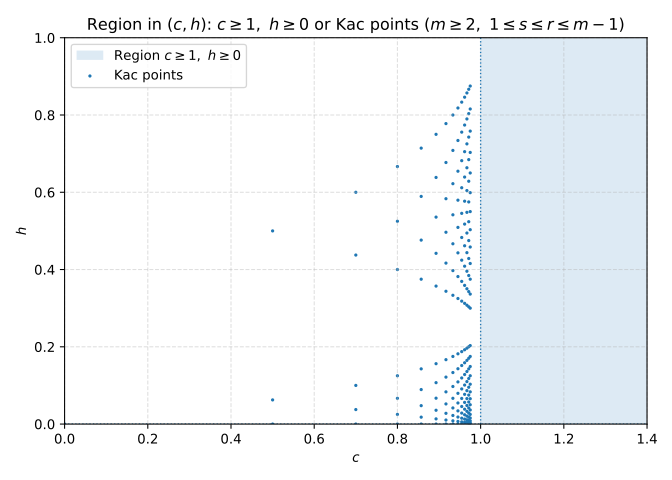
Friedan–Qiu–Shenker Classification
An
-highest weight representation for is unitary if and only if either and or for some integers , . In particular, and .
Proof See Ref.1.
Energy Bounds
Lemma
Fix a UHW representation
of . Suppose containing some vector such that is an irreducible HW representation of , and there exists such that . Then for all , Moreover,
Proof We use the standard basis
Remark
The above proof closely follows the original argument of Goodman and Wallach (1985). However, it is worth noting that there appears to be a minor typo in their equation (2.8): a term of the form
seems to be missing. This omission has been corrected in the version presented here. The discrepancy is ultimately harmless for our purposes, since we only require the expression to be bounded by a polynomial, and the conclusion remains unaffected.
Lemma
Fix a UHW representation
of . For all and ,
Proof Every
Theorem
If
is a UHW representation of , then it can be extended to a continuous projective representation of , such that for all and , where is the completion of with respect to , and are scales of associated with . In particular, if and , then is essentially self-adjoint as a unbounded operator on .
Proof By the above lemma, since
Stone’s theorem immediately implies the following corollary:
Corollary
Suppose
is a real vector field on . Then is a strongly continuous one-parameter group of unitary operators on .
References
Details of the non-unitarity proof for highest weight representations of the Virasoro algebra
Goodman and Wallach, Projective unitary positive-energy representations of