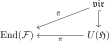
Goodman and Wallach proved the following theorem in 1984, which was originally conjectured by V. Kac:
Integrability Theorem
Every unitary highest weight projective representation of integrates to a continuous projective representation of .
Proof Since every UHW projective representation can be completely reduced to irreducible submodules isomorphic to , once every integrates, we can integrate an arbitrary module by taking the (Hilbert) direct sum of the implementers on its irreducible summands. Now we show every unitary is integrable step by step using the phase-shift condition:
is integrable.
satisfies the phase-shift condition iff satisfies for some .
If is positive, satisfies the phase-shift condition iff satisfies.
Let . If then satisfies the phase-shift condition.
If , then satisfies the phase-shift condition.
satisfies the phase-shift condition for all .
Step 5 follows from step 3 and 4 by choosing so that . Step
Let be a compact neighborhood of in , we can find a neighborhood of in , and therefore a neighborhood of the identity in , such that for all , is self-adjoint, bounded above and has a unique weight with multiplicity one. Pick a highest weight vector , we define be the cyclic submodule generated by . We observe the following facts:
The inner product on is contravariant because .
If is a UHW representation, then is also a UHW representation. Let be the isomorphism such that .
In summary, for any “good” , we have a tuple where are scales associated with the contravariant inner product and .
Now recall that , let us denote . Then we can first apply a -twist to obtain , and then apply a -twist to obtain . Note that so is a scalar multiple of , thus . We claim that is invariant under and is dense in . Indeed, for any and , so it is invariant. To see that it is dense, since contains , by the proposition, contains , which is dense in .
Therefore, by the estimates, is continuous at all scales, and extends to a unitary operator for all .
Step 3: Extend to
Let . We now consider a local representation defined by . Since is contractible, induces a unique . It is already a projective representation of , now we recover the 2-cocycle from the complex line bundle defined by where is the line spanned by . As is contractible and precompact, this line bundle is locally trivial (thus well-defined). Therefore we can take a global continuous section of with unit norm, say . Notice that is connected, so it is generated by any neighborhood of identity, in particular, for any , we can choose such that . Then we define Intertwining property and cyclicity of ensure that is independent of the choice of factorization, and it is a projective representation of .
Step 4: Extend to
Finally, we extend to . Note that through . We define It is straightforward to verify that is a projective representation of extending .