It is well known that a Lie algebra representation does not, in general, integrate to a representation of the corresponding Lie group. In fact, even under seemingly “perfect” conditions this may fail. Nelson’s counterexample demonstrates that, even when every element of a Lie algebra is essentially skew-adjoint on a common invariant domain in a Hilbert space, the representation need not integrate to a unitary group representation.
A Sufficient Condition for Essential Skew-Adjointness
Before turning to Nelson’s construction, we first state a lemma that provides a sufficient condition for an operator to be essentially skew-adjoint.
Lemma
Let be a smooth manifold with a volume form. Let be the space of square-integrable functions with respect to the measure induced by . Suppose a vector field is skew-symmetric on the domain of compactly supported smooth functions . Let be the flow generated by , and define the closure of the set of points where the flow is not defined at time as . If for some , , then is essentially skew-adjoint.
Proof First, we show that the skew-symmetry of implies that its flow preserves the volume. The skew-symmetry condition is that for all , we have . This means: In terms of the Lie derivative and the volume form , this is . Using the product rule, . The integral of the first term vanishes, because, by Cartan’s formula and Stoke’s theorem, we have: The first term is zero because vanishes on the boundary . The second term is zero because is a form of degree . This leaves us with: Since this holds for all , it must be that . This is the condition for the flow to be volume-preserving.
Now, for , we define a family of operators associated with the flow: Since the flow is volume-preserving and , this operator is bounded on : where we performed a change of variables.
For any , must vanish a.e. on , as for all . If , then , so is dense in . Therefore, is densely defined.
To show is essentially skew-adjoint, it suffices to show that its adjoint has no real eigenvalues, i.e., . Suppose for some , and for some . For any , consider the time evolution of the inner product : So . By the Cauchy-Schwarz inequality and the fact that is bounded, we have:It follows that , which implies . A similar argument for leads to . By considering the flow backwards in time, using , which leads to , again implying . Thus, , and is essentially skew-adjoint.
Nelson’s Counterexample
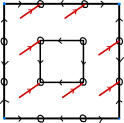
Now, we construct the counterexample. Consider a genus-4 smooth manifold, defined by the following diagram:
That is, a band bounded by two concentric squares, where each point is identified with its opposite, the four vertices are also identified, and the 12 marked points in the above diagram are removed. Finally, we obtain a two-dimensional surface resembling a bunch of bananas, except that each “banana” is a torus:
Let’s define an abelian Lie algebra of vector fields on : These are skew-symmetric operators on the common invariant domain . For any , the flow is not defined on only 7 discrete line segments, i.e., once fixed the slope, there are only 7 possible ways to hit the hole:
Therefore, for all . By the lemma, every operator is essentially skew-adjoint.
However, this collection of operators does not generate a unitary group representation. Let and , being the closure of unit vector fields (as operators).
Consider a function supported on the lower-left square . Applying shifts its support in the -direction to , which lies on one of the tori. Subsequently, applying preserves this torus, so has support . On the other hand, applying first shifts the support to , and then preserves that region, so has support . Thus .
This demonstrates that even when each element of a Lie algebra is individually well-behaved (essentially skew-adjoint), additional conditions are needed to ensure the existence of an associated group representation. These additional conditions are then the Nelson’s commutator theorem.
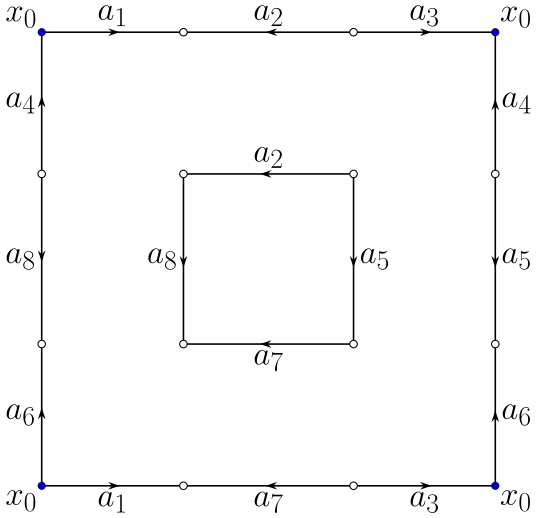 That is, a band bounded by two concentric squares, where each point is identified with its opposite, the four vertices are also identified, and the 12 marked points in the above diagram are removed. Finally, we obtain a two-dimensional surface resembling a bunch of bananas, except that each “banana” is a torus: