Interval Coding
Modified Cumulative Distribution Function
Given a discrete probability distribution
, we define the modified cumulative distribution function as: where is the usual cumulative distribution function.
Shannon-Fano-Elias Coding
For each outcome
,
- Calculate the value of modified cumulative distribution function
. - Calculate the length of the required binary string
. - Convert the value to binary
. - Trim the binary string to the required length
, assign the trimmed binary string to the outcome as its codeword.
e.g. Suppose
| 4 | |||||
| 5 | |||||
| 3 | |||||
| 3 |
Therefore we have the code
Lossless Property
Proposition
The Shannon-Fano-Elias code is lossless.
Proof Denote the Shannon-Fano-Elias code as
Prefix Property
Proposition
Shannon-Fano-Elias code is prefix free.
Proof According to the previous argument, we know that
Shannon-Fano-Elias Decoding
Shannon-Fano-Elias Decoding
To decode a given bitstring,
- start with the first bit, compute the corresponding binary interval;
- if the interval is strictly contained within that of a codeword:
- output the corresponding outcome
- skip over any redundant bits for this codeword
- repeat the process with the remaining bits
- otherwise include next bit and compute the corresponding interval.
e.g. Suppose we have 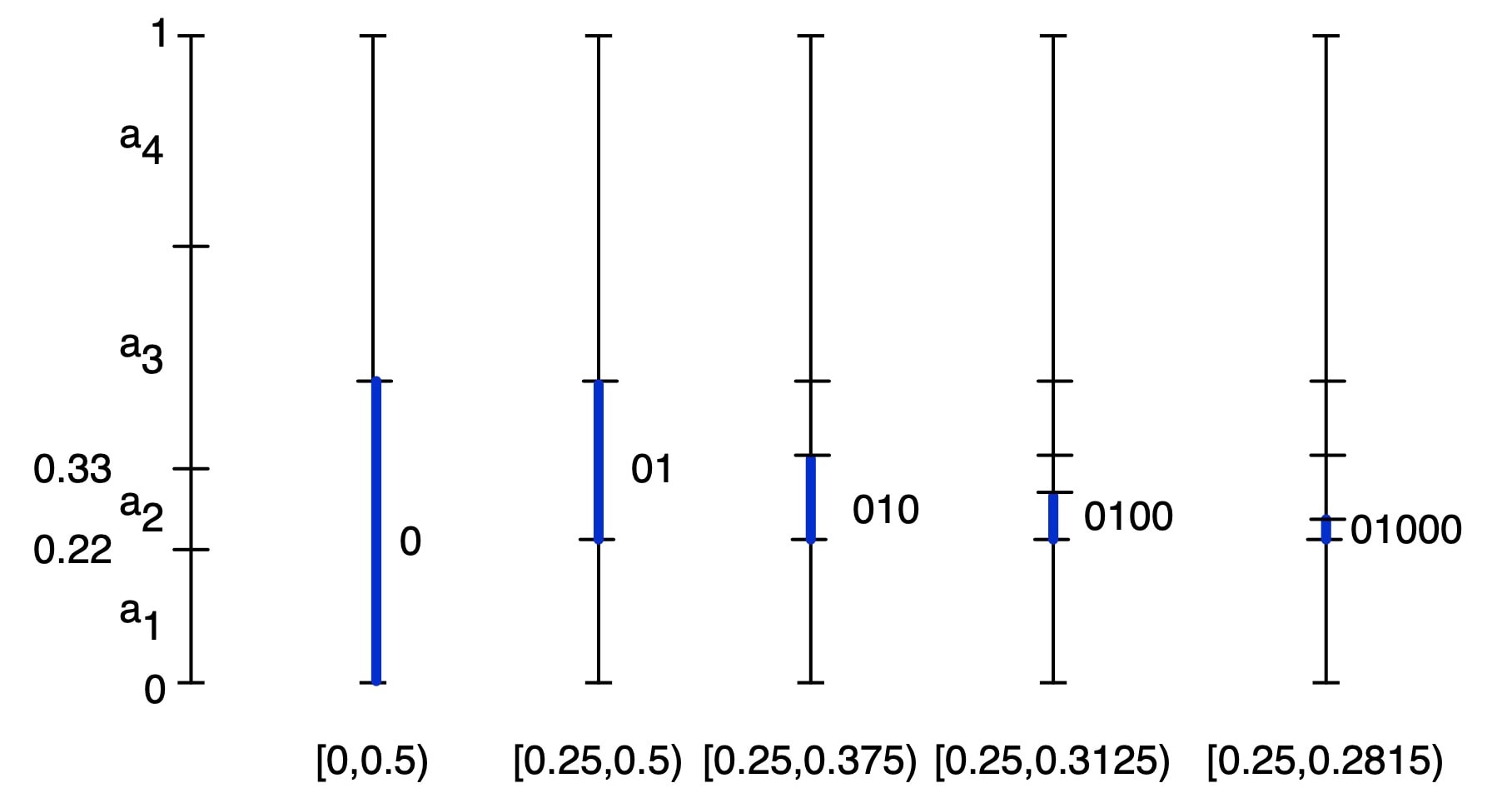 We could actually stop the process once we see
Expected Length
Theorem
The expected length of a Shannon-Fano-Elias code
on ensemble satisfies:
Proof